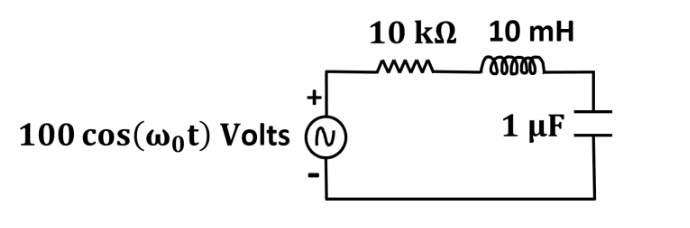
For the shown series RLC circuit, R=10 kΩ, L=10 mH and C=1 μF. The resistor-voltage amplitude equals the source-voltage amplitude. Find ω₀ in rad/s. Source voltage is 100cos(ω₀t) V.
The resistor voltage equals source amplitude only when the net reactive impedance vanishes, since |Vᵣ/Vₛ|=R/√[R²+(ωL−1/(ωC))²]. Resonance gives ω₀=1/√(LC)=1/√(10⁻²×10⁻⁶)=10⁴ rad/s, A.
More AC Circuits and Resonance questions
GATE 2022 BM Q33– A series circuit with R=10 Ω, L=50 mH and C=100 μF consumes power P from a 200 V,50 Hz…
GATE 2022 BM Q54– A series RLC circuit uses a 220 V,50 Hz supply. R and C are fixed and L is varied to…
GATE 2021 BM Q14– An ideal 1/3 H inductor is connected to a 50 Hz sinusoidal voltage source. The energy…
GATE 2020 BM Q40– Two parallel loads draw 10 kW at unity power factor and 10 kVA at 0.6 lagging power…
GATE 2025 BM Q37– Voltage V s=5(100t+/2) V drives current I=10(100t+/6) mA. Find average dissipated power in…
GATE 2025 BM Q40– Vin=10cos(1000t) V drives the shown 3 kΩ resistor in series with a parallel 1 kΩ–1 μF…