Networks, Signals and Systems · LTI Systems · 2 marks · Numerical answer
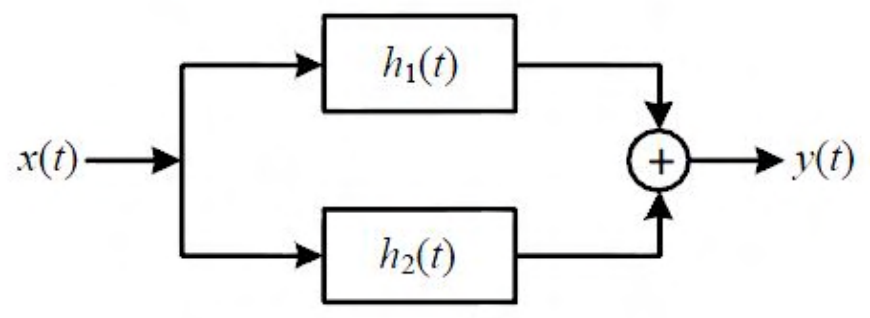
Consider the parallel combination of LTI systems shown. Their impulse responses are $h_1(t)=2\delta(t+2)-3\delta(t+1)$ and $h_2(t)=\delta(t-2)$. If x(t) is a unit step, the energy of y(t) is ________.
Parallel systems add their outputs. Convolution with each shifted impulse gives $$y(t)=2u(t+2)-3u(t+1)+u(t-2).$$ Thus y is zero before −2, equals 2 on [−2,−1), equals −1 on [−1,2), and returns to zero from t=2 onward.
Integrate its squared magnitude over these intervals: $E=2^2(1)+(-1)^2(3)=$ **7**. Endpoint values do not affect the integral.
More LTI Systems questions
GATE 2026 EC Q13– The Laplace Transform of the signal x(t) = u(t-2) * (t\,u(t)) is given by which of the…
GATE 2026 EC Q16– The response of a discrete time system y[n] obeys the following relation: y[n]=56…
GATE 2026 EC Q47– Consider the discrete time system (S) with input x[n] and output y[n] as shown in the…
GATE 2025 EC Q17– Consider the discrete-time system below with input x[n] and output y[n]. In the figure, h…
GATE 2024 EC Q21– A causal and stable LTI system with impulse response h(t) produces an output y(t) for an…
GATE 2024 EC Q24– For a causal discrete-time LTI system with transfer function H(z)=2z2+3(z+13)(z-13), which…