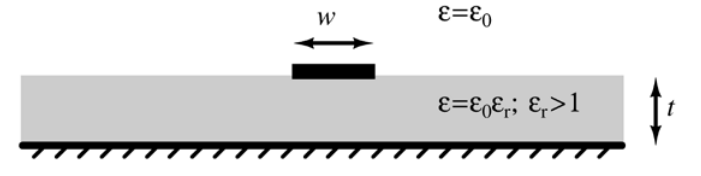
A lossless microstrip has trace width w over a practically infinite ground plane, separated by a slab of thickness t and relative permittivity $\epsilon_r>1$. Its inductance per unit length is L and characteristic impedance is $Z_0$. Which inequality is always satisfied?
The parallel-plate contribution to capacitance per unit length is $C_{pp}=\epsilon_0\epsilon_rw/t$. The microstrip also has fringing electric fields outside the rectangular region under the trace, so its total capacitance C exceeds this contribution.
For a lossless line, $Z_0=\sqrt{L/C}$. A larger C makes this smaller than $\sqrt{L/C_{pp}}=\sqrt{Lt/(\epsilon_0\epsilon_rw)}$. Thus **B**.
More Transmission Lines questions
GATE 2016 EC (EC2) Q64– The figure shows lossless lines T 1,T 2 and input reflection magnitude versus frequency.…
GATE 2026 EC Q34– For a lossless passive two-port network, S 11 and S 21 intersect at –3 dB. For a lossy…
GATE 2026 EC Q52– A complex load (in Ω) is represented as L=0.530 on the Smith chart. A co-axial cable with…
GATE 2025 EC Q64– A 50 Ω lossless transmission line is terminated with a load Z L of (50-j75) Ω. If the…
GATE 2024 EC Q15– Consider a lossless transmission line terminated with a short circuit as shown in the…
GATE 2024 EC Q58– A lossless transmission line with characteristic impedance Z 0=50\ is terminated with an…