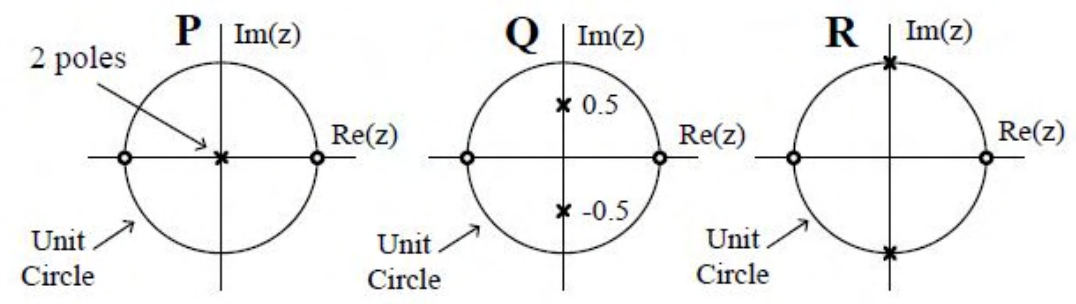
Correct answer: (B) All three are band-pass filters.
Explanation
Each plot has zeros at z=+1 and z=−1. These locations correspond to ω=0 and ω=π, so each response rejects both DC and the highest discrete-time frequency.
Their nonzero intermediate-frequency response gives the intended **band-pass classification, B**. The different poles shape the passband, rather than changing those endpoint zeros.
**Source qualification:** R has poles on the unit circle at ±j. It is an ideal resonant limiting case and is not BIBO stable; the classification does not imply a realizable stable filter at those exact pole locations.
More Applications of Fourier Transform for continuous and discrete time signals, Laplace Transform and Z transform questions
GATE 2015 EE (EE2) Q39– The signal is x(t)=ej10t for t ≤1 and zero otherwise. Its Fourier transform is
GATE 2015 EE (EE2) Q45– For X(z)=2z+4-4/z+3/z2, let y[n] be the first difference x[n]−x[n−1]. Then Y(z) is
GATE 2026 EE Q11– Consider the infinite-length, discrete-time sequence x[n]=0.9 n , where n is an integer.…
GATE 2025 EE Q61– An ideal low pass filter has frequency response given by H(j)=cases1,&…
GATE 2024 EE Q16– If u(t) is the unit step function, then the region of convergence (ROC) of the Laplace…
GATE 2024 EE Q33– Let X() be the Fourier transform of the signal x(t)=e-t4 t,-<t<. The value of the…