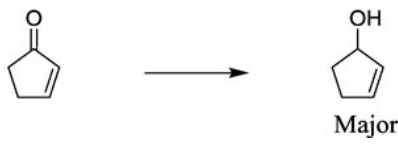
The transformation reduces the carbonyl to an alcohol while preserving the conjugated C=C bond. Luche conditions, $NaBH_4/CeCl_3$, favour 1,2 reduction of the enone and give the allylic alcohol, C. Catalytic hydrogenation tends to reduce the alkene, Wolff–Kishner removes the carbonyl oxygen, and dissolving-metal reduction does not provide the selected chemoselective alcohol conversion.
More Reduction: Catalytic homogeneous and heterogeneous hydrogenation. Metal based reductions using Li/Na in liquid ammonia, magnesium, zinc, titanium, and samarium. Hydride transfer reagents: NaBH4, L-selectride, K-selectride, Luche reduction, LiAlH4 and DIBAL-H. questions
GATE 2020 CY Q12– Find the major product of the shown substituted anisole sequence: (i) Li/liquid NH₃,…
GATE 2019 CY Q45– Identify the major product after the illustrated chiral carboxylic acid–ester is treated…
GATE 2024 CY Q42– The major products X and Y in the following reaction sequence are
GATE 2026 CY Q14– The major product formed in the following reaction is
GATE 2023 CY Q11– The major product formed in the given reaction is
GATE 2023 CY Q48– Product(s) formed in the reaction below is(are)