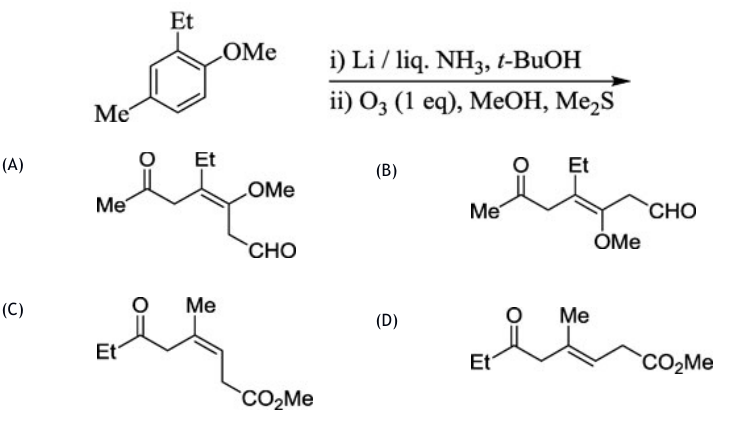
First apply Birch reduction: the methoxy substituent is electron donating, so the methoxy-bearing carbon remains in an unsaturated part of the reduced ring. Next, one equivalent of ozone cleaves the more electron-rich enol-ether double bond. Work-up converts its methoxy-bearing end to a methyl ester and its alkyl-bearing end to a ketone, while the other double bond remains. Tracking the Et and Me substituents gives the ester–ketone alkene drawn in C, including its retained alkene geometry.
More Reduction: Catalytic homogeneous and heterogeneous hydrogenation. Metal based reductions using Li/Na in liquid ammonia, magnesium, zinc, titanium, and samarium. Hydride transfer reagents: NaBH4, L-selectride, K-selectride, Luche reduction, LiAlH4 and DIBAL-H. questions
GATE 2019 CY Q45– Identify the major product after the illustrated chiral carboxylic acid–ester is treated…
GATE 2024 CY Q42– The major products X and Y in the following reaction sequence are
GATE 2026 CY Q14– The major product formed in the following reaction is
GATE 2023 CY Q11– The major product formed in the given reaction is
GATE 2023 CY Q48– Product(s) formed in the reaction below is(are)
GATE 2022 CY Q11– The major product M formed in the following reaction is