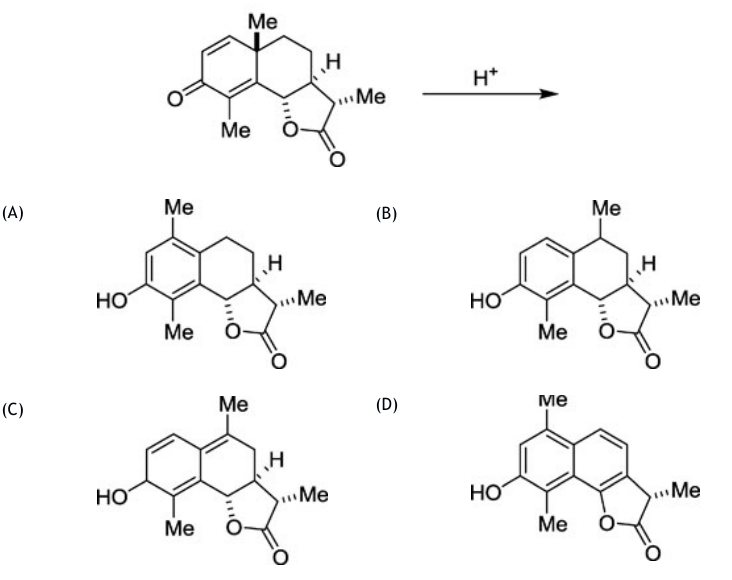
Protonation of the dienone oxygen activates the system for the dienone–phenol rearrangement. A neighbouring angular methyl group migrates from the ring junction to the adjacent carbon while π bonds reorganize. Loss of a proton restores aromaticity and furnishes the phenolic ring. The lactone portion retains its shown connectivity and stereochemistry. These changes, rather than simple enolization or complete aromatization of both rings, give A.
More Types of Reactions: Nucleophilic and electrophilic substitution reactions (both aromatic and aliphatic). Addition reactions to carbon-carbon and carbon-heteroatom (N and O) multiple bonds. Elimination reactions. Reactive intermediates – carbocation, carbanion, carbenes, nitrenes, arynes and free radicals. Molecular rearrangements. Barton decarboxylation and Barton-McCombie reaction, Hunsdiecker reaction. questions
GATE 2020 CY Q38– The two stereoisomeric bromocyclohexanols shown react separately with Ag₂O. Select their…
GATE 2019 CY Q44– For the illustrated iodide, identify the major product under n-Bu₃SnH/AIBN in benzene on…
GATE 2019 CY Q47– Cyclobutanecarbaldehyde reacts with CH₃MgCl and then HCl as illustrated. Which major…
GATE 2024 CY Q24– The reaction(s) that yield(s) X as the major product is (are)
GATE 2025 CY Q26– Among the given options, the possible product(s) that can be obtained from the following…
GATE 2025 CY Q54– The process(es) and/or intermediate(s) through which the following transformation proceeds…