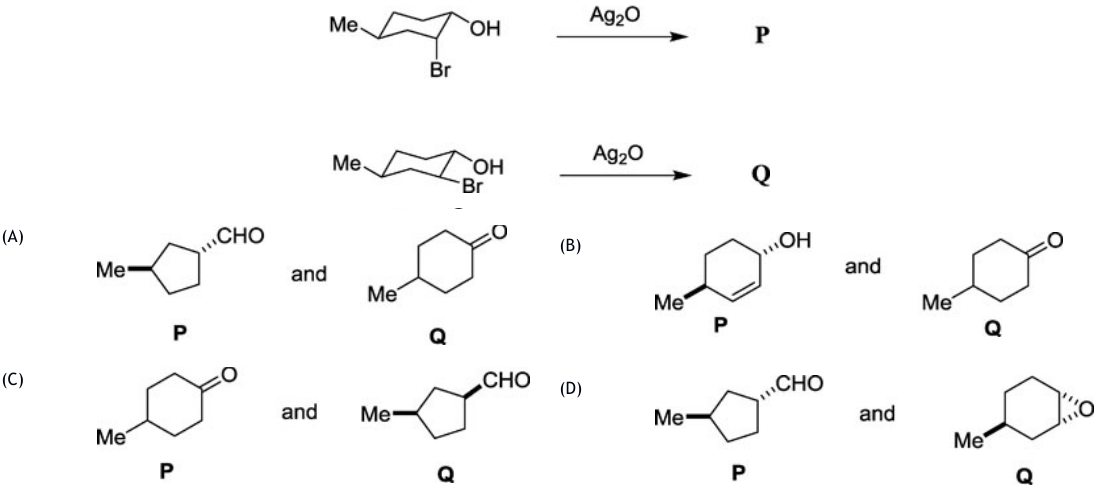
Silver promotes halide departure and the hydroxyl-bearing substrate undergoes a stereoelectronically controlled semipinacol rearrangement. The bond able to migrate must align with the departing C–Br bond. In one stereoisomer the suitable migrating carbon–carbon bond contracts the ring to a cyclopentanecarbaldehyde; in the other, the suitable hydride shift retains the six-membered ring and forms a cyclohexanone. Applying the drawn chair geometries gives P = the ketone and Q = the contracted aldehyde, C. The stereoisomers therefore need not give the same skeleton.
More Types of Reactions: Nucleophilic and electrophilic substitution reactions (both aromatic and aliphatic). Addition reactions to carbon-carbon and carbon-heteroatom (N and O) multiple bonds. Elimination reactions. Reactive intermediates – carbocation, carbanion, carbenes, nitrenes, arynes and free radicals. Molecular rearrangements. Barton decarboxylation and Barton-McCombie reaction, Hunsdiecker reaction. questions
GATE 2019 CY Q44– For the illustrated iodide, identify the major product under n-Bu₃SnH/AIBN in benzene on…
GATE 2019 CY Q47– Cyclobutanecarbaldehyde reacts with CH₃MgCl and then HCl as illustrated. Which major…
GATE 2024 CY Q24– The reaction(s) that yield(s) X as the major product is (are)
GATE 2025 CY Q26– Among the given options, the possible product(s) that can be obtained from the following…
GATE 2025 CY Q54– The process(es) and/or intermediate(s) through which the following transformation proceeds…
GATE 2026 CY Q11– The major product formed in the following reaction is