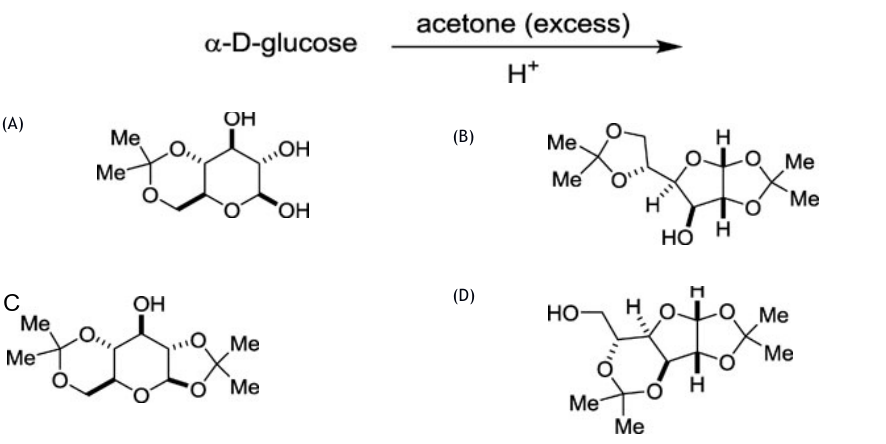
Acid catalyzes reversible ketal formation between acetone and suitably oriented hydroxyl groups. Glucose can equilibrate to its furanose form, allowing favourable 1,2- and 5,6-isopropylidene protection. The product is 1,2:5,6-di-O-isopropylidene-α-D-glucofuranose, leaving the 3-OH free. Among the drawn structures, B has this furanose ring and the two correct acetals; the pyranose alternatives and different hydroxyl pairing are incorrect.
More Biomolecules: Structure, properties and reactions of mono- and di-saccharides, physicochemical properties of amino acids, chemical synthesis of peptides, chemical structure determination of peptides and proteins, structural features of proteins, nucleic acids, lipids, steroids, terpenoids, carotenoids, and alkaloids. questions
GATE 2024 CY Q41– Fischer presentation of D-(-)-fructose is given below. The correct structure of…
GATE 2025 CY Q17– A disaccharide X does NOT show mutarotation in aqueous solution. Acidic hydrolysis of X…
GATE 2025 CY Q32– Partial hydrolysis of a pentapeptide yields all possible tripeptides and dipeptides. The…
GATE 2026 CY Q51– Chymotrypsin selectively cleaves a peptide at the carboxyl side of the amino acids having…
GATE 2023 CY Q32– Product(s) formed in the given reaction is(are)
GATE 2022 CY Q14– A tripeptide on treatment with PhNCS (pH = 8.0) followed by heating with dilute HCl…