GATE 2025 CY – Question 17
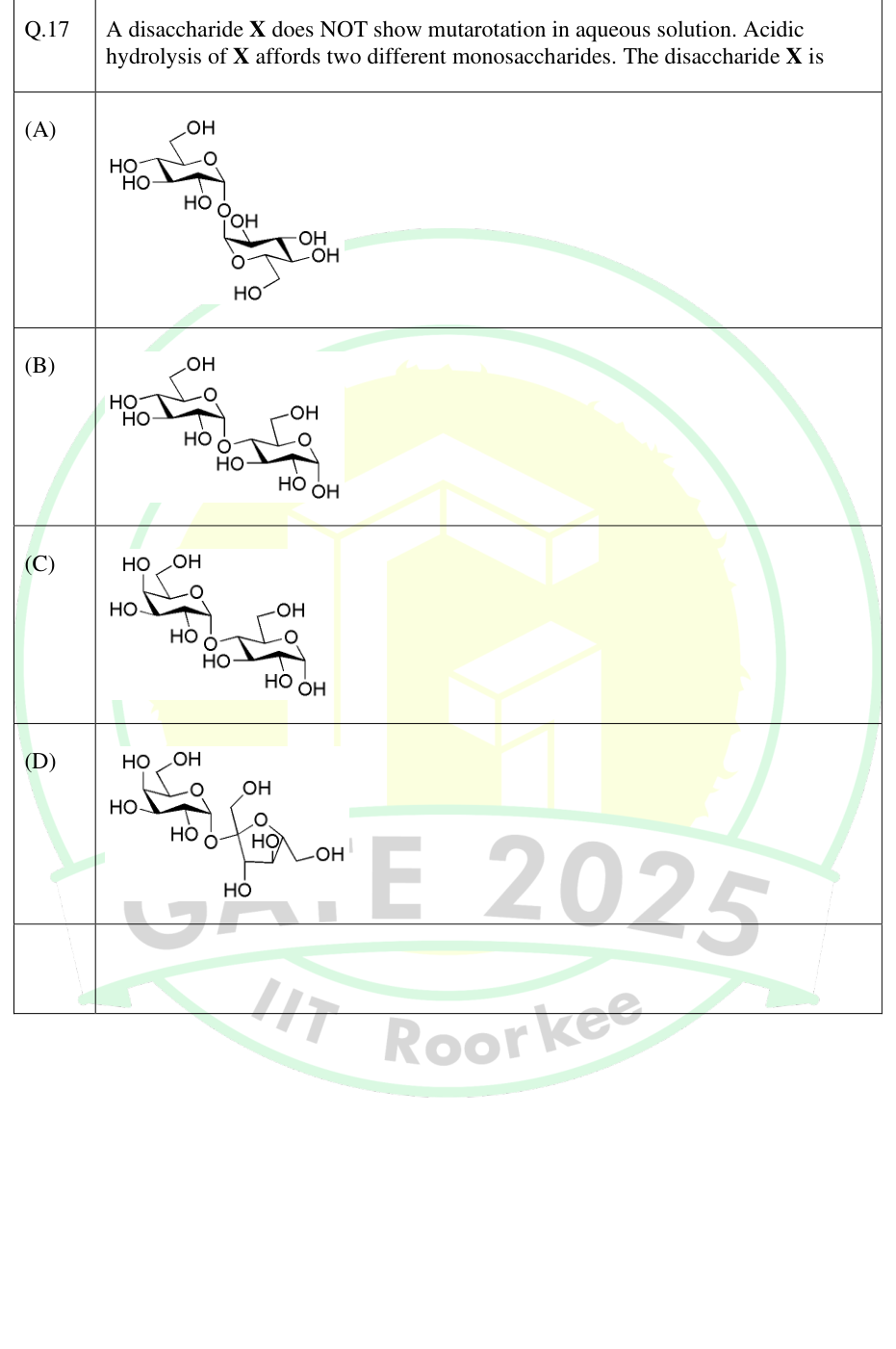
A disaccharide X does NOT show mutarotation in aqueous solution. Acidic hydrolysis of X affords two different monosaccharides. The disaccharide X is
Practise this question in The GATE Grind →
Show answer and explanation
Correct answer: (D) Option D in the figure
Explanation
**Mutarotation** is the slow change in optical rotation of a sugar solution, caused by the ring opening and closing of a **free hemiacetal (anomeric) group**. A sugar that has no free hemiacetal group cannot open to the aldehyde or ketone form, so it does not mutarotate.
- A disaccharide with a **glycosidic bond between the two anomeric carbons** has no free hemiacetal group. It is a **non-reducing sugar** and does not show mutarotation.
- Hydrolysis of that disaccharide gives two **different** monosaccharides.
**Sucrose** fits both clues: the glycosidic bond joins the anomeric carbon of glucose (C-1) to the anomeric carbon of fructose (C-2), so there is no free hemiacetal, and acid hydrolysis gives **glucose and fructose**. Lactose, maltose and cellobiose have a free anomeric centre, so they mutarotate. The answer is the sucrose structure (option D).