GATE 2025 CY – Question 16
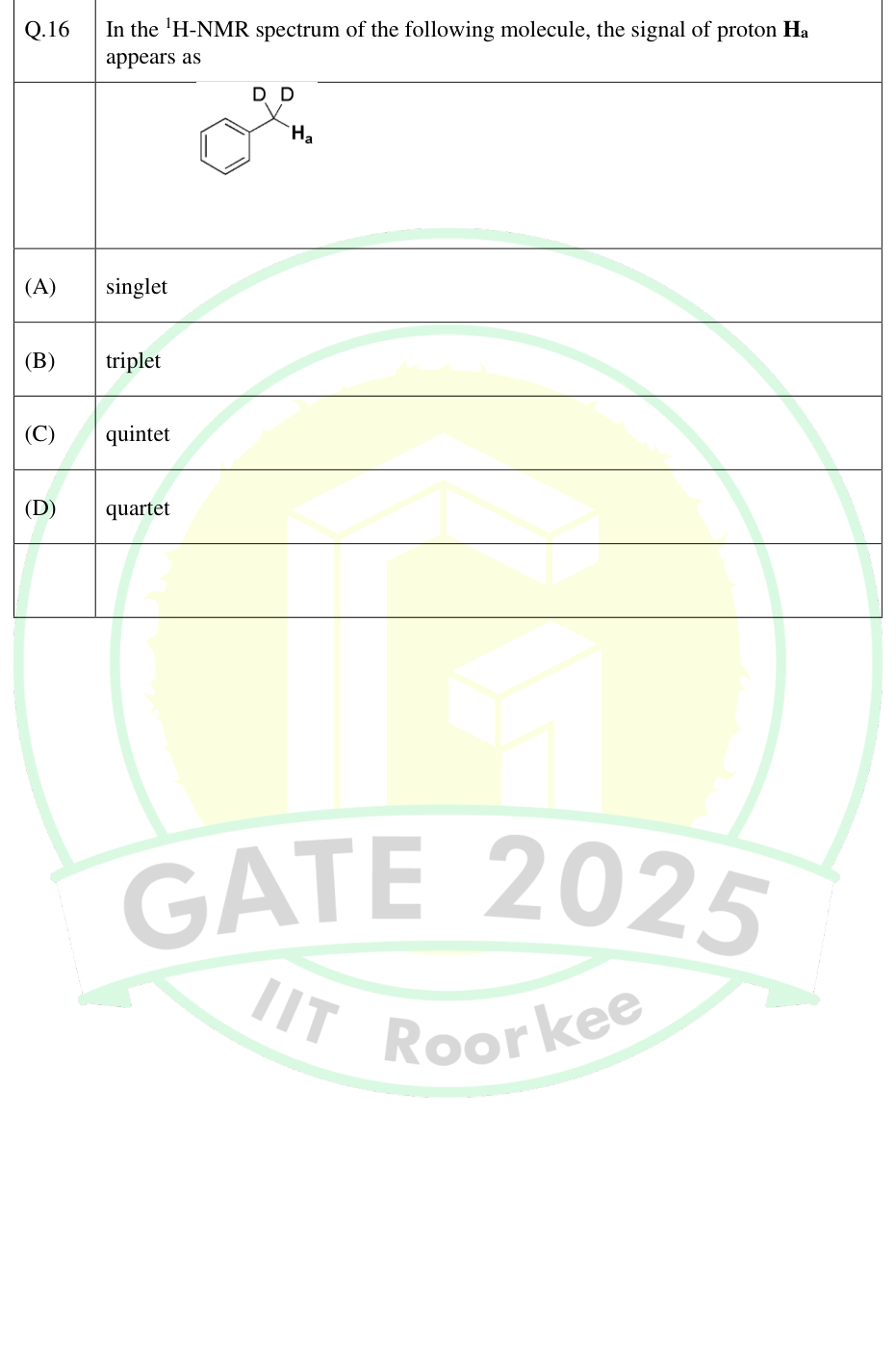
In the $^1$H-NMR spectrum of the following molecule, the signal of proton $H_a$ appears as
Practise this question in The GATE Grind →
Show answer and explanation
Correct answer: (C) quintet
Explanation
In the group $-\text{CD}_2-$ the two deuterium atoms are **spin-1 nuclei** ($I=1$) and they are equivalent.
**Multiplicity rule.** A proton coupled to $n$ equivalent nuclei of spin $I$ appears as a multiplet with
$$2nI+1\text{ lines}.$$
For $n=2$ and $I=1$:
$$2(2)(1)+1=5\text{ lines}.$$
So $H_a$ appears as a **quintet** (option C). (For ordinary protons, with $I=\tfrac12$, the same rule gives the familiar $n+1$ pattern, which would be a triplet for two equivalent H.)