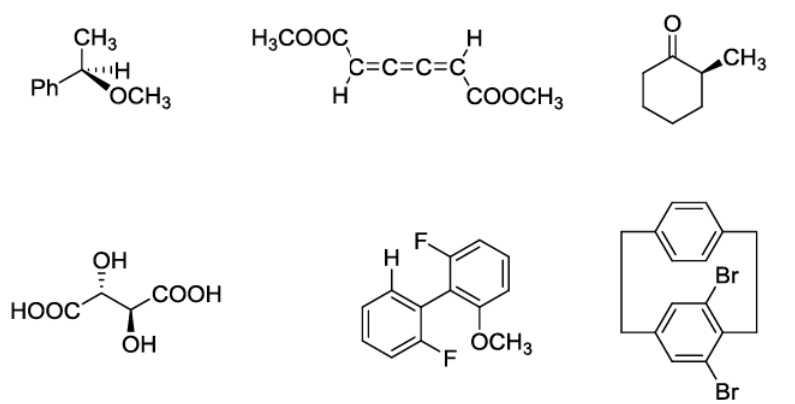
Number the compounds left to right in the top row, then left to right in the bottom row. Compound 1 has a stable tetrahedral stereocentre and is optically active; compound 6 has configurationally stable planar chirality. Compound 2 has an odd number of cumulative double bonds and coplanar terminal substituents. Compound 3 racemizes by enolization, compound 4 is meso, and compound 5 lacks sufficient rotational restriction for stable atropisomerism at room temperature. Thus 2,3,4,5 are inactive: four compounds.
More Stereochemistry: Chirality and symmetry of organic molecules with or without chiral centres and determination of their absolute configurations and optical purity. Relative stereochemistry in compounds having more than one stereogenic centre. Homotopic, enantiotopic and diastereotopic atoms, groups and faces. Conformational analysis of acyclic and cyclic compounds. Geometrical isomerism and optical isomerism. Configurational and conformational effects, atropisomerism, and neighbouring group participation on reactivity and selectivity/specificity. Stereoselective and stereospecific synthesis. Enantiomeric excess. questions
GATE 2019 CY Q56– Pure (R)-2-bromobutane has specific rotation −112.00°. A sample rotates −82.88°. Find the…