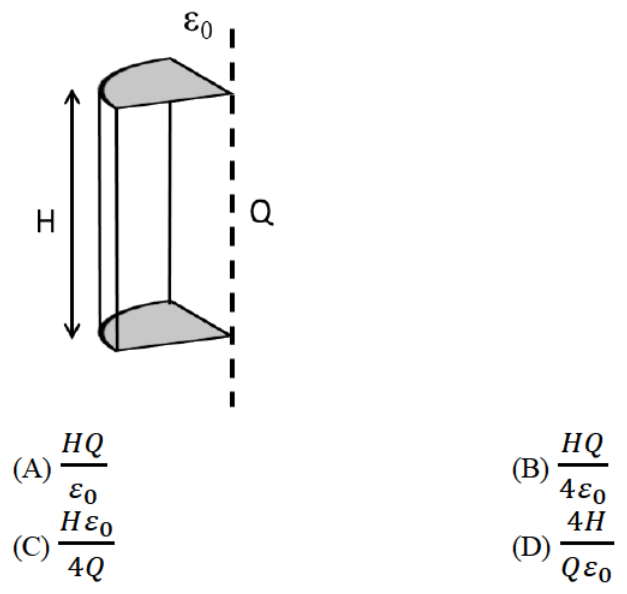
What is the electric flux $\left(\int\vec E\cdot d\vec a\right)$ through a quarter-cylinder of height $H$ (as shown in the figure) due to an infinitely long line charge along the axis of the cylinder with a charge density of $Q$?
Gauss's law for a line charge $Q$ per unit length: the flux through a closed cylinder of height $H$ is $\dfrac{Q\,H}{\varepsilon_0}$, and it all leaves through the curved surface (the field is radial).
The charge is symmetric about the axis, so the flux splits equally over the angle. A quarter-cylinder takes a quarter of it: $\dfrac{HQ}{4\varepsilon_0}$.
More Maxwell's Equations questions
GATE 2019 EC Q22– In the table shown, List I and List II, respectively, contain terms appearing on the…
GATE 2019 EC Q46– Two identical copper wires W1 and W2, placed in parallel as shown in the figure, carry…
GATE 2016 EC Q34– Concentric spherical shells of radii 2 m, 4 m, and 8 m carry uniform surface charge…
GATE 2016 EC Q61– The current density in a medium is given by J = 4002(r2 + 4)a r Am-2 The total current and…
GATE 2015 EC Q34– Consider a straight, infinitely long, current carrying conductor lying on the z-axis.…
GATE 2014 EC (EC1) Q35– A point charge +q is distance d from an infinite grounded metal plate in a medium of…