GATE 2019 EC – Question 51
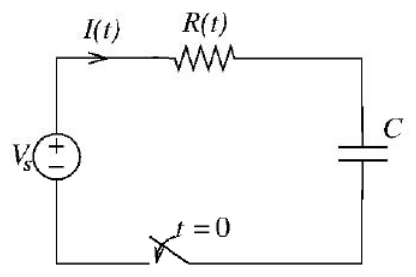
The RC circuit shown below has a variable resistance $R(t)$ given by the following expression:
$$R(t)=R_0\left(1-\frac tT\right)\quad\text{for }0\le t<T$$
where $R_0=1\ \Omega$, and $C=1$ F. We are also given that $T=3R_0C$ and the source voltage is $V_s=1$ V. If the current at time $t=0$ is 1 A, then the current $I(t)$, in amperes, at $t=T/2$ is ________ (rounded off to 2 decimal places).
Practise this question in The GATE Grind →
Show answer and explanation
Correct answer: 0.24 to 0.26
Explanation
Let $u=V_s-v_C$. Since $I=\frac{u}{R(t)}$ and $I=C\frac{dv_C}{dt}=-C\frac{du}{dt}$, we have $\frac{du}{dt}=-\frac{u}{1-t/3}$, so $u=\left(1-\frac t3\right)^3$ (with $u(0)=1$ since $I(0)=1$ A). Then $I=\frac uR=\left(1-\frac t3\right)^2$. At $t=\frac T2=1.5$ s, $I=0.5^2=0.25$ A.