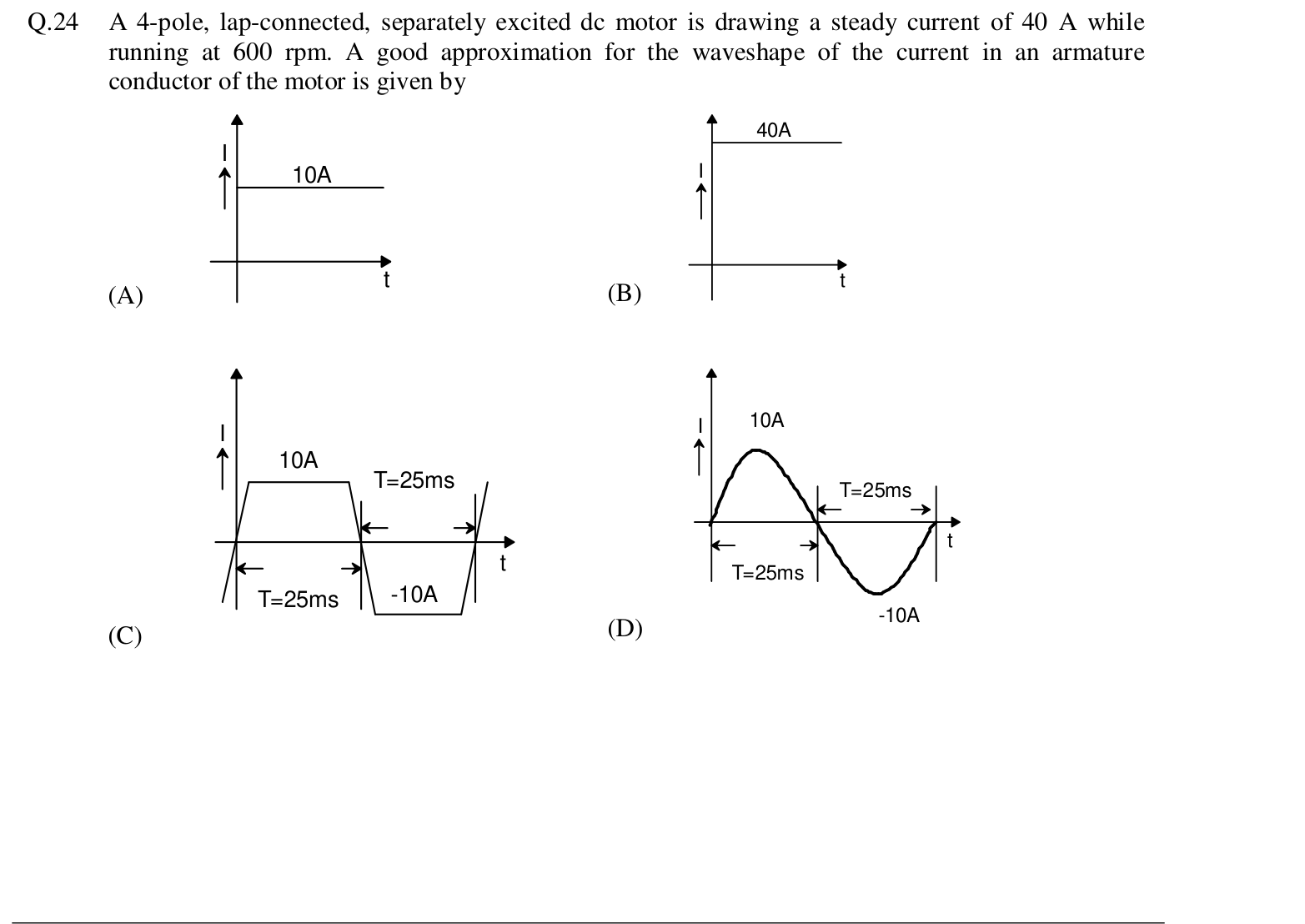
A 4-pole, lap-connected, separately excited dc motor is drawing a steady current of 40 A while running at 600 rpm. A good approximation for the waveshape of the current in an armature conductor of the motor is given by
A lap winding on 4 poles has 4 parallel paths, so each conductor carries $\frac{40}{4} = 10$ A. The current reverses each time the conductor moves from under a north pole to under a south pole. At 600 rpm the rotor makes 10 revolutions per second, and a pair of poles passes every $\frac{1}{20}$ s, so each half-period is 25 ms. The current changes direction quickly at commutation, giving a trapezoidal wave between +10 A and -10 A.
More DC machines: separately excited, series and shunt, motoring and generating mode of operation and their characteristics, speed control of dc motors questions
GATE 2016 EE Q57– A DC shunt generator delivers 45 A at a terminal voltage of 220 V. The armature and the…
GATE 2015 EE Q31– A separately excited DC generator has an armature resistance of 0.1\ and negligible…
GATE 2015 EE Q58– A separately excited DC motor runs at 1000 rpm on no load when its armature terminals are…
GATE 2015 EE Q59– A DC motor has the following specifications: 10 hp, 37.5 A, 230 V; flux/pole = 0.01 Wb,…
GATE 2017 EE Q57– A 220 V DC series motor runs drawing a current of 30 A from the supply. Armature and field…
GATE 2017 EE Q59– A separately excited DC generator supplies 150 A to a 145 V DC grid. The generator is…