GATE 2016 EC – Question 50
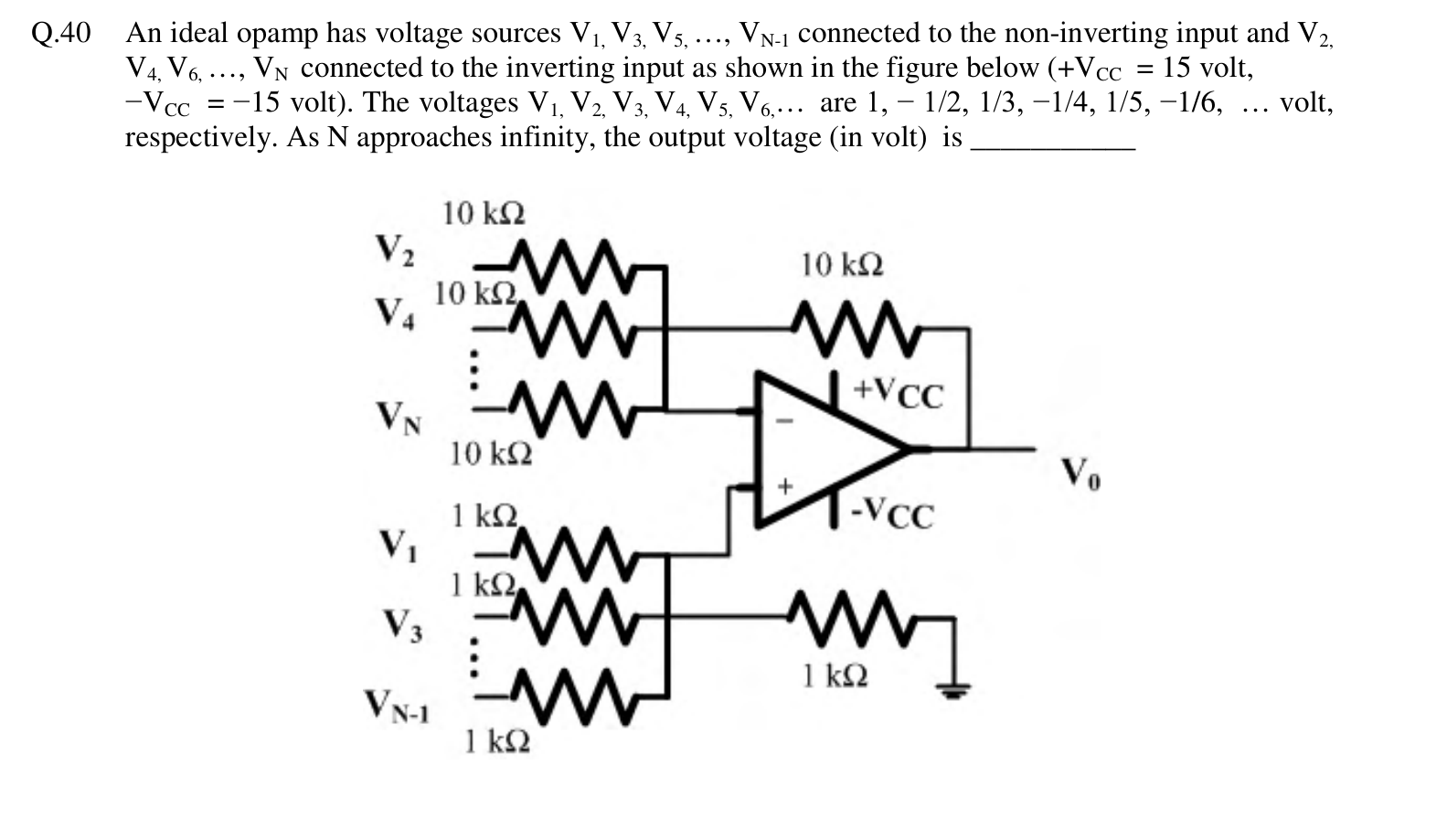
An ideal opamp has voltage sources $V_1, V_3, V_5, \ldots, V_{N-1}$ connected to the non-inverting input and $V_2, V_4, V_6, \ldots, V_N$ connected to the inverting input as shown in the figure below ($+V_{CC} = 15$ volt, $-V_{CC} = -15$ volt). The voltages $V_1, V_2, V_3, V_4, V_5, V_6, \ldots$ are $1, -1/2, 1/3, -1/4, 1/5, -1/6, \ldots$ volt, respectively. As $N$ approaches infinity, the output voltage (in volt) is ________
Practise this question in The GATE Grind →
Show answer and explanation
Correct answer: 14.9 to 15.5
Explanation
With $M = \frac{N}{2}$ sources on each side, the non-inverting node is at $V_+ = \frac{\sum V_{odd}}{M + 1}$ and the inverting node is at $V_- = \frac{\sum V_{even} + V_0}{M + 1}$. Setting $V_+ = V_-$ gives $V_0 = \sum V_{odd} - \sum V_{even}$. Because the even-numbered voltages are negative, this is $1 + \frac{1}{2} + \frac{1}{3} + \frac{1}{4} + \cdots$, the harmonic series, which grows without limit as $N \to \infty$. The output therefore saturates at $+V_{CC} = 15$ V.