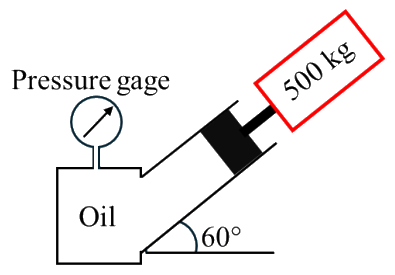
A hydraulic crane supports a mass of 500 kg with its piston-cylinder actuator, inclined at 60° with horizontal, as shown in the figure below. The diameter of the piston is 30 cm and gravitational acceleration is 10 m/s$^2$. Neglecting mass of the piston, the reading of the pressure gage in kPa (gage) is
The piston acts along its own inclined axis, so the force it carries is the component of the weight along that axis: $500 \times 10 \times \sin 60° = 4330$ N. The piston area is $\frac{\pi}{4}(0.3)^2 = 0.0707$ m$^2$. The gauge pressure is $\frac{4330}{0.0707} = 61{,}260$ Pa, which is 61.26 kPa.
More Fluid properties, fluid statics, forces on submerged bodies, stability of floating bodies questions
GATE 2025 ME Q15– Let a spherical block of ice at -7 °C be exposed to atmospheric air at 30 °C with the…
GATE 2023 ME Q64– The figure shows two fluids held by a hinged gate. The atmospheric pressure is P a = 100…
GATE 2022 ME (ME2) Q62– A uniform wooden rod (specific gravity = 0.6, diameter = 4 cm and length = 8 m) is…
GATE 2021 ME (ME1) Q31– A pressure measurement device fitted on the surface of a submarine, located at a depth H…
GATE 2020 ME (ME2) Q24– Which condition determines stable equilibrium of a partially submerged floating body?
GATE 2020 ME (ME2) Q25– In the space above the mercury column of a barometer tube, the gauge pressure of vapour is…