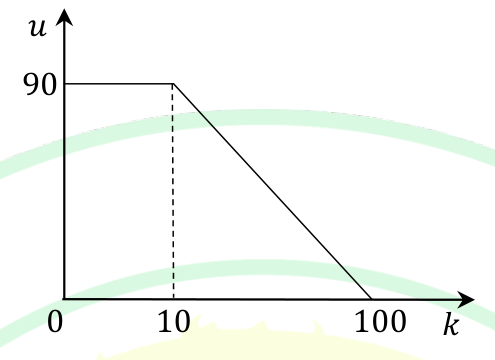
The speed-density relation on a one-way, single lane road is shown in the figure, where speed $u$ is in km/hour and density $k$ is in vehicles/km. The maximum flow (in vehicles/hour) on this road is
The flow is $q = ku$. For $k \le 10$, $u = 90$ and $q = 90k$, which reaches 900 at $k = 10$. For $10 \le k \le 100$ the line gives $u = 100 - k$, so $q = k(100 - k)$, which has its maximum where $100 - 2k = 0$, at $k = 50$, giving $q = 50 \times 50 = 2500$ veh/h. That is larger than the 900 at the end of the first part.
More Fundamental relationships of traffic flow questions
GATE 2025 CE (CE2) Q50– The free flow speed of a highway is 100 km/h and its capacity is 4000 vehicle/h. Assume…
GATE 2024 CE (CE1) Q44– The free mean speed is 60 km/hr on a given road. The average space headway at jam density…
GATE 2024 CE (CE1) Q63– The figure presents the trajectories of six vehicles within a time-space domain. The…
GATE 2023 CE (CE1) Q46– A plot of speed-density relationship (linear) of two roads (Road A and Road B) is shown in…
GATE 2023 CE (CE2) Q50– The figure presents the time-space diagram for when the traffic on a highway is suddenly…
GATE 2022 CE (CE1) Q44– Consider the four points P, Q, R, and S shown in the Greenshields fundamental speed-flow…