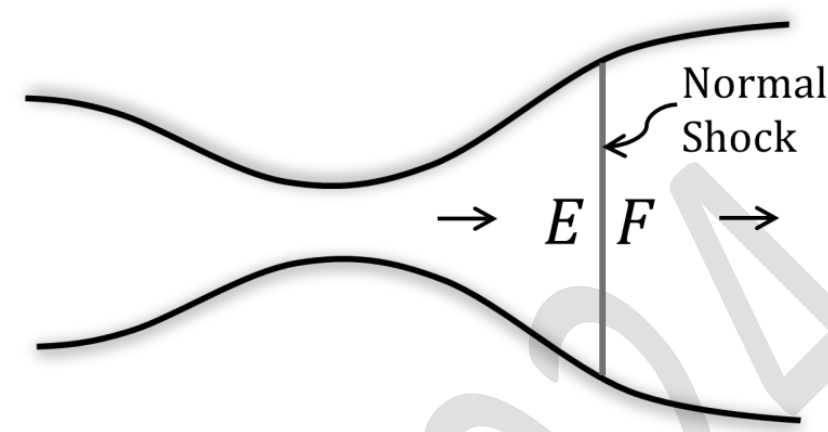
Steady, compressible flow of air takes place through an adiabatic converging-diverging nozzle, as shown in the figure. For a particular value of pressure difference across the nozzle, a stationary normal shock wave forms in the diverging section of the nozzle. If $E$ and $F$ denote the flow conditions just upstream and downstream of the normal shock, respectively, which of the following statement(s) is/are TRUE?
Static pressure at $E$ is lower than the static pressure at $F$
Density at $E$ is lower than the density at $F$
Mach number at $E$ is lower than the Mach number at $F$
Specific entropy at $E$ is lower than the specific entropy at $F$
Correct answer: (A) Static pressure at $E$ is lower than the static pressure at $F$; (B) Density at $E$ is lower than the density at $F$; (D) Specific entropy at $E$ is lower than the specific entropy at $F$
Explanation
The flow is supersonic upstream of a normal shock and subsonic downstream of it. Across the shock the static pressure, the density, the temperature and the specific entropy all increase, and the Mach number falls. So the pressure at E is lower than at F (A), the density at E is lower (B) and the entropy at E is lower (D), which is the second law at work. The Mach number at E is higher than at F, so C is false.
More One-dimensional compressible flow, nozzles questions
GATE 2023 ME Q20– Consider an isentropic flow of air (ratio of specific heats = 1.4) through a duct as shown…
GATE 2022 ME (ME1) Q30– The figure shows a purely convergent nozzle with a steady, inviscid compressible flow of…
GATE 2022 ME (ME2) Q24– Consider a steady flow through a horizontal divergent channel, as shown in the figure,…
GATE 2021 ME (ME2) Q30– Consider adiabatic flow of air through a duct. At a given point in the duct, velocity of…
GATE 2021 ME (ME2) Q33– An object is moving with a Mach number of 0.6 in an ideal gas environment, which is at a…
GATE 2026 ME Q25– An ideal gas passes isothermally through a long horizontal uniform cross-section pipe…