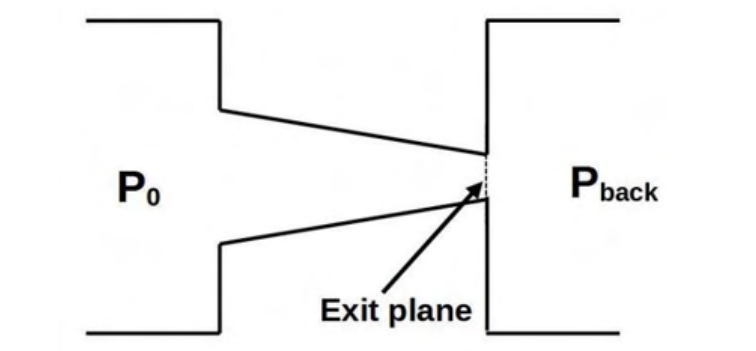
The figure shows a purely convergent nozzle with a steady, inviscid compressible flow of an ideal gas with constant thermophysical properties operating under choked condition. The exit plane shown in the figure is located within the nozzle. If the inlet pressure ($P_0$) is increased while keeping the back pressure ($P_{back}$) unchanged, which of the following statements is/are true?
Mass flow rate through the nozzle will remain unchanged.
Mach number at the exit plane of the nozzle will remain unchanged at unity.
Mass flow rate through the nozzle will increase.
Mach number at the exit plane of the nozzle will become more than unity.
Correct answer: (B) Mach number at the exit plane of the nozzle will remain unchanged at unity.; (C) Mass flow rate through the nozzle will increase.
Explanation
A convergent nozzle that is choked has $M = 1$ at the exit, and it cannot go beyond this (B true, D false). The choked mass flow is proportional to the stagnation pressure, $\dot{m} \propto P_0$, so it increases when $P_0$ is raised (C true, A false).
More One-dimensional compressible flow, nozzles questions
GATE 2022 ME (ME2) Q24– Consider a steady flow through a horizontal divergent channel, as shown in the figure,…
GATE 2021 ME (ME2) Q30– Consider adiabatic flow of air through a duct. At a given point in the duct, velocity of…
GATE 2021 ME (ME2) Q33– An object is moving with a Mach number of 0.6 in an ideal gas environment, which is at a…
GATE 2026 ME Q25– An ideal gas passes isothermally through a long horizontal uniform cross-section pipe…
GATE 2024 ME Q40– Steady, compressible flow of air takes place through an adiabatic converging-diverging…
GATE 2023 ME Q20– Consider an isentropic flow of air (ratio of specific heats = 1.4) through a duct as shown…