GATE 2026 CH – Question 42
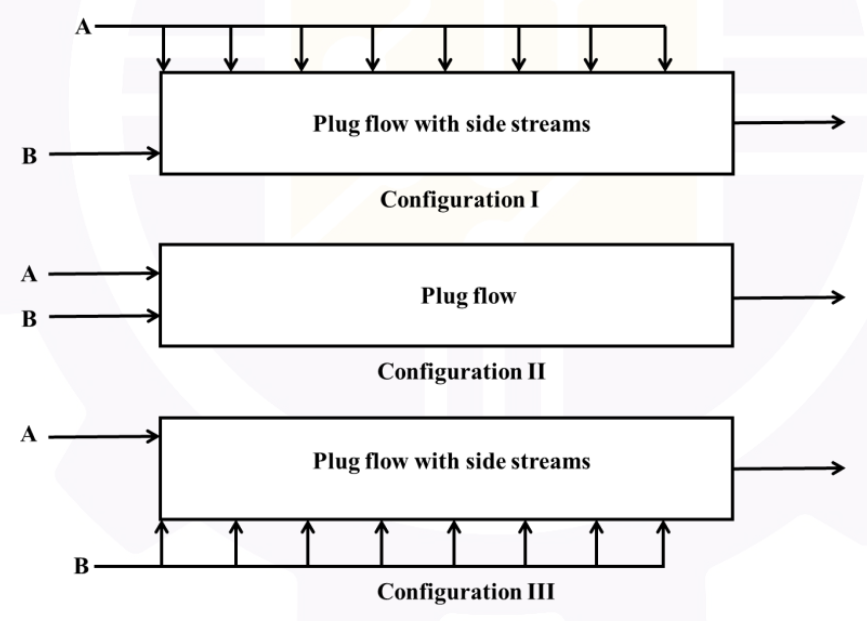
Consider the following homogeneous isothermal liquid-phase parallel reactions carried out in three reactor configurations (having identical volumes and same operating temperatures), as shown in the figure.
$A + B \to D$, rate of formation of D: $r_D = k_1C_AC_B$
$A + B \to U$, rate of formation of U: $r_U = k_2C_A^2C_B$
where D is the desired product and U is the undesired product. The inlet concentrations of A and B are the same in all three configurations ($C_{A0} = C_{B0} = 1$ mol L$^{-1}$). The total molar feed flow rate of A ($F_{A0}$) and that of B ($F_{B0}$) are the same in all three configurations ($F_{A0} = F_{B0} = 10$ mol min$^{-1}$). In configuration I, $F_{A0}$ is equally distributed among all the inlets. Similarly, in configuration III, $F_{B0}$ is equally distributed among all the inlets. Assuming plug flow behavior, at steady state, which one of the following statements is CORRECT?
Practise this question in The GATE Grind →
Show answer and explanation
Correct answer: (B) Configuration I gives the highest selectivity of the desired product.
Explanation
The instantaneous selectivity is $\frac{r_D}{r_U} = \frac{k_1C_AC_B}{k_2C_A^2C_B} = \frac{k_1}{k_2C_A}$. It does not depend on $C_B$ and it is larger when $C_A$ is lower. So the best arrangement keeps the concentration of A as low as possible everywhere in the reactor. Configuration I adds A gradually through the side streams, so $C_A$ stays low all along the reactor. Configuration II has A at its highest at the inlet, and configuration III also starts with all of A at the inlet. Hence configuration I gives the highest selectivity of the desired product.