GATE 2026 CH – Question 64
Cyclohexane (C$_6$H$_{12}$) is produced from benzene (C$_6$H$_6$) and hydrogen (H$_2$) according to the following reaction.
C$_6$H$_6$ + 3H$_2$ ⟶ C$_6$H$_{12}$
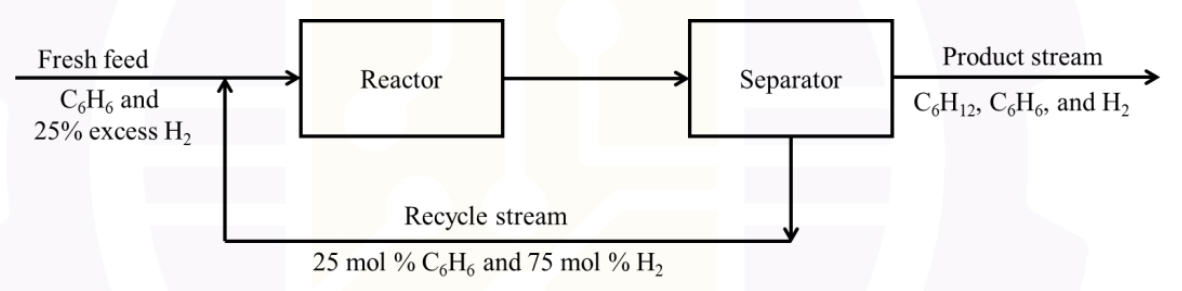
Consider the process flow diagram shown in the figure.
[Figure: fresh feed of C$_6$H$_6$ and 25% excess H$_2$ goes into a reactor, then to a separator. The product stream of C$_6$H$_{12}$, C$_6$H$_6$ and H$_2$ leaves the separator, and a recycle stream of 25 mol % C$_6$H$_6$ and 75 mol % H$_2$ goes back to the reactor inlet.]
In this process, the overall and single-pass conversions are 90% and 25%, respectively. The recycle stream contains 25 mol % C$_6$H$_6$ and 75 mol % H$_2$. If the fresh feed contains 25% excess H$_2$, at steady state, the ratio of the molar flow rate of recycle stream to that of the fresh feed is _________ (rounded off to one decimal place).
Practise this question in The GATE Grind →
Show answer and explanation
Correct answer: 10.35 to 10.45
Explanation
Take 1 mol of fresh benzene (with 3.75 mol H$_2$, which is 25 % more than the 3 mol needed) and let $R$ be the recycle flow, which carries $0.25R$ mol benzene. The reactor feed contains $1 + 0.25R$ mol benzene and the single-pass conversion is 25 %, so $0.75(1 + 0.25R)$ mol benzene leaves the reactor. Of this, $0.25R$ goes to recycle and the rest leaves in the product. The overall conversion is 90 %, so the product contains $0.1$ mol benzene. Hence $0.75(1 + 0.25R) = 0.25R + 0.1$, that is $0.65 = 0.0625R$, so $R = 10.4$. The check on hydrogen also works: the recycle holds $0.75 \times 10.4 = 7.8$ mol H$_2$, which is 3 times the 2.6 mol benzene, as in the feed. So the ratio of recycle to fresh feed (per mole of fresh benzene) is 10.4.