GATE 2023 ME – Question 46
Cylindrical bars P and Q have identical lengths and radii, but are composed of different linear elastic materials. The Young's modulus and coefficient of thermal expansion of Q are twice the corresponding values of P. Assume the bars to be perfectly bonded at the interface, and their weights to be negligible.
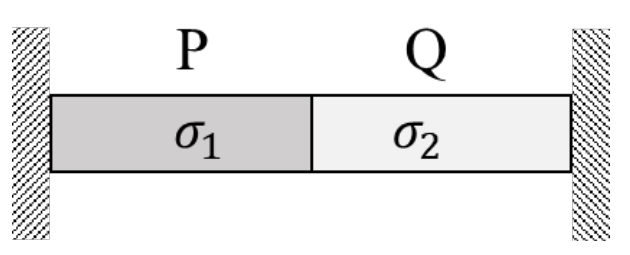
The bars are held between rigid supports as shown in the figure and the temperature is raised by $\Delta T$. Assume that the stress in each bar is homogeneous and uniaxial. Denote the magnitudes of stress in P and Q by $\sigma_1$ and $\sigma_2$, respectively.
Which of the statement(s) given is/are CORRECT?
Practise this question in The GATE Grind →
Show answer and explanation
Correct answer: (A) The interface between P and Q moves to the left after heating; (D) $\sigma_1 = \sigma_2$
Explanation
The bars are in series with the same cross-sectional area, so the axial force in both is the same, and so $\sigma_1 = \sigma_2 = \sigma$ (D is true and C is false). The compatibility condition is that the total length does not change: $(\alpha\Delta T - \frac{\sigma}{E})L + (2\alpha\Delta T - \frac{\sigma}{2E})L = 0$, which gives $3\alpha\Delta T = \frac{3\sigma}{2E}$ and $\sigma = 2E\alpha\Delta T$ (compressive). The length change of bar P is $(\alpha\Delta T - 2\alpha\Delta T)L = -\alpha\Delta TL$, so P shortens, and since its left end is fixed, the interface moves to the left (A is true).