GATE 2023 ME – Question 47
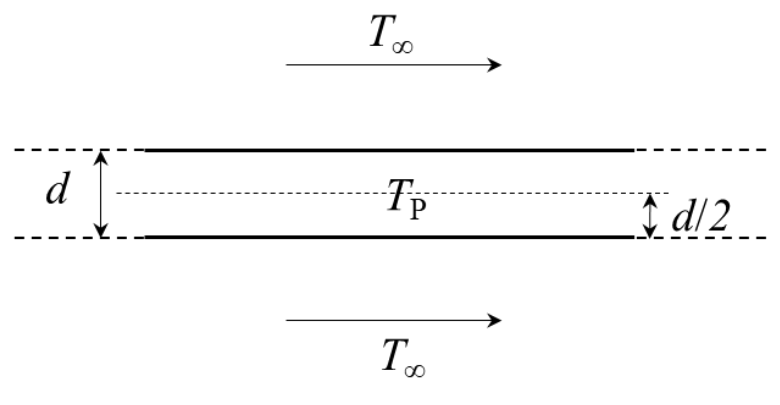
A very large metal plate of thickness $d$ and thermal conductivity $k$ is cooled by a stream of air at temperature $T_\infty = 300$ K with a heat transfer coefficient $h$, as shown in the figure. The centerline temperature of the plate is $T_P$. In which of the following case(s) can the lumped parameter model be used to study the heat transfer in the metal plate?
Practise this question in The GATE Grind →
Show answer and explanation
Correct answer: (A) $h = 10$ Wm$^{-2}$K$^{-1}$, $k = 100$ Wm$^{-1}$K$^{-1}$, $d = 1$ mm, $T_P = 350$ K; (C) $h = 100$ Wm$^{-2}$K$^{-1}$, $k = 1000$ Wm$^{-1}$K$^{-1}$, $d = 1$ mm, $T_P = 325$ K
Explanation
The lumped model is valid when the Biot number is small, $Bi = \frac{hL_c}{k} < 0.1$. For a plate cooled on both faces, the characteristic length is $L_c = \frac{V}{A} = \frac{d}{2}$. (A) $Bi = \frac{10 \times 0.0005}{100} = 5 \times 10^{-5}$, valid. (B) $Bi = \frac{100 \times 0.5}{100} = 0.5$, not valid. (C) $Bi = \frac{100 \times 0.0005}{1000} = 5 \times 10^{-5}$, valid. (D) $Bi = \frac{1000 \times 0.5}{1} = 500$, not valid. The temperatures $T_P$ do not change the Biot number.