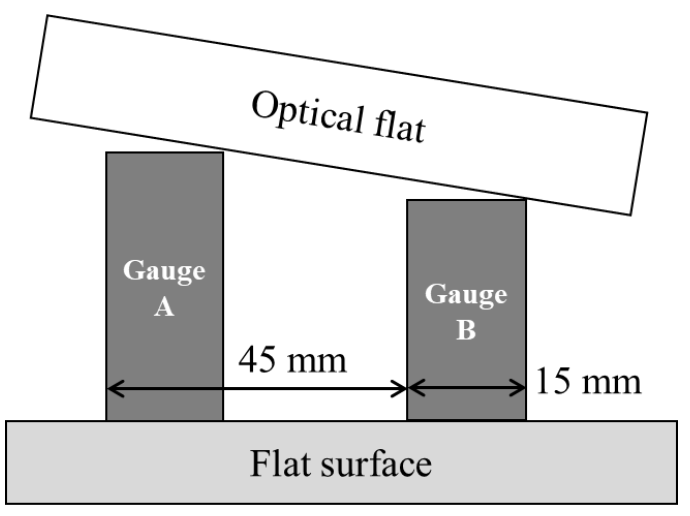
An optical flat is used to measure the height difference between a reference slip gauge A and a slip gauge B. Upon viewing via the optical flat using a monochromatic light of wavelength 0.5 µm, 12 fringes were observed over a length of 15 mm of gauge B. If the gauges are placed 45 mm apart, the height difference of the gauges is ______________ µm. (Answer in integer)
Each fringe corresponds to a change in the air gap of $\frac{\lambda}{2} = 0.25$ µm. The 12 fringes over 15 mm correspond to a gap change of $12 \times 0.25 = 3$ µm, so the optical flat is tilted by 3 µm per 15 mm, that is 0.2 µm per mm. The gauges are 45 mm apart, so the height difference is $0.2 \times 45 = 9$ µm.
More Interferometry, form and finish measurement questions
GATE 2021 ME (ME1) Q20– Consider the surface roughness profile as shown in the figure. The center line average…
GATE 2020 ME (ME2) Q22– The figure symbolically represents surface texture in a perpendicular lay orientation.…
GATE 2017 ME (ME2) Q63– A pin of diameter 25+0.020 +0.010 mm is electroplated with thickness 2.0+0.005 mm. Neglect…
GATE 2016 ME (ME3) Q62– Two optically flat plates of glass are kept at a small angle θ as shown in the figure.…
GATE 2026 ME Q33– A two-dimensional surface profile is obtained over a sampling length by using a contact…