GATE 2024 CH – Question 23
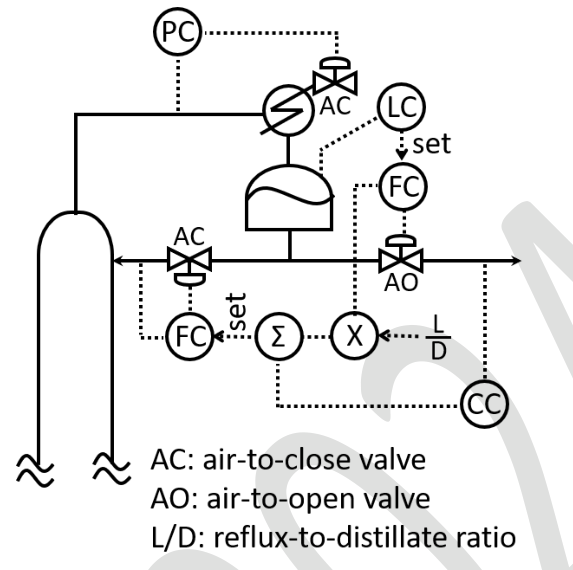
Consider the control structure for the overhead section of a distillation column shown in the figure. The composition controller (CC) controls the heavy key impurity in the distillate by adjusting the setpoint of the reflux flow controller in a cascade arrangement. The sign of the controller gain for the pressure controller (PC) and that for the composition controller (CC) are, respectively,
Practise this question in The GATE Grind →
Show answer and explanation
Correct answer: (D) positive, negative
Explanation
The gain of each controller has to make the loop a negative feedback loop. For the pressure loop, a rising pressure needs more cooling, that is a more open valve. The valve is air-to-close, so the controller output has to fall when the pressure rises. That is a reverse-acting controller, with a positive gain (the usual convention $u = K_c(SP - PV)$). For the composition loop, a rising impurity in the distillate needs more reflux, so the output (the L/D setpoint) has to rise when the impurity rises, a direct-acting controller with a negative gain. So the signs are positive for PC and negative for CC.