GATE 2023 CH – Question 27
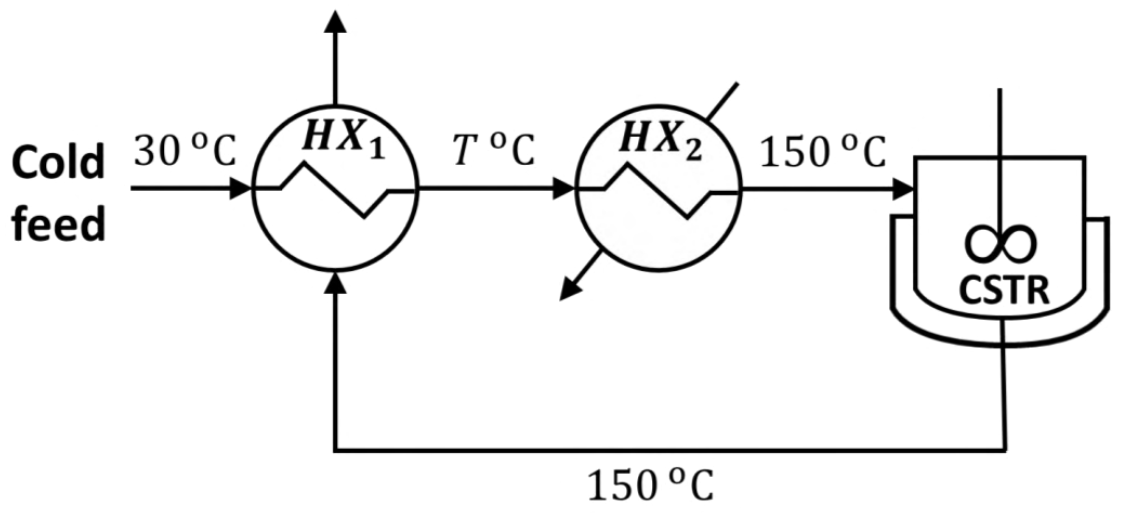
An isothermal jacketed continous stirred tank reactor (CSTR) operating at 150 °C is shown in the figure below. The cold feed entering the system at 30 °C is preheated to a temperature $T$ ($T <$ 150 °C) using a heat exchanger $HX_1$. This preheated feed is further heated to 150 °C using the utility heater $HX_2$. The mass flow rate and heat capacity are same for all the process streams, and the overall heat transfer coefficient is independent of temperature. Which one of the following statements is the CORRECT action to take if it is desired to increase the value of $T$ ?
Practise this question in The GATE Grind →
Show answer and explanation
Correct answer: (C) Increase the heat transfer area of $HX_1$ and decrease the heat duty of $HX_2$.
Explanation
The preheater $HX_1$ uses the hot reactor effluent. A larger area for $HX_1$ transfers more heat, so the feed leaves at a higher temperature $T$. The heater $HX_2$ then has to supply only the rest of the heat up to 150 °C, so its duty falls. The correct action is to increase the area of $HX_1$ and decrease the duty of $HX_2$.