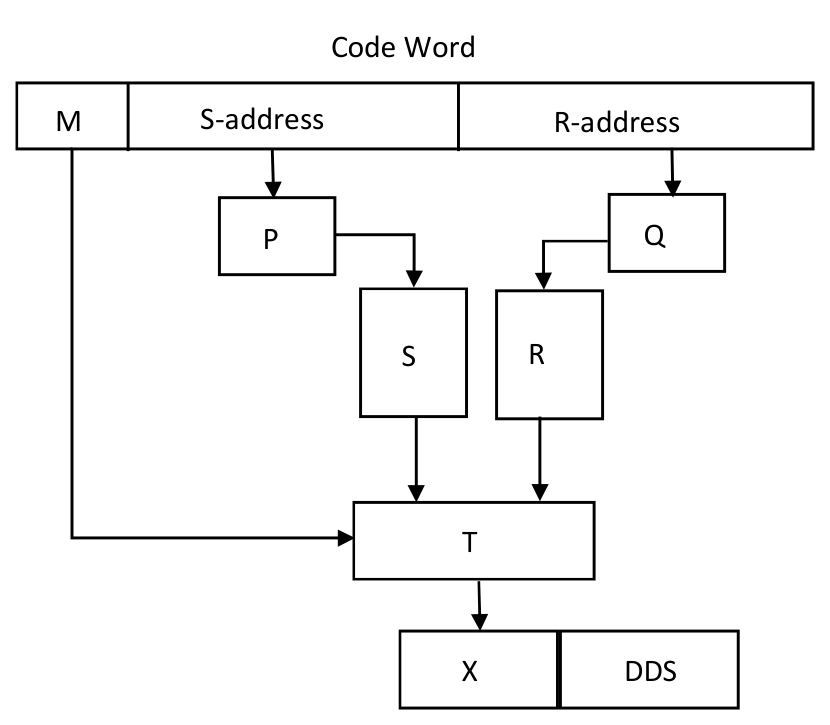
Consider a digital display system (DDS) shown in the figure that displays the contents of register X. A 16-bit code word is used to load a word in X, either from S or from R. S is a 1024-word memory segment and R is a 32-word register file. Based on the value of mode bit M, T selects an input word to load in X. P and Q interface with the corresponding bits in the code word to choose the addressed word. Which one of the following represents the functionality of P, Q, and T?
P is 10:1 multiplexer; Q is 5:1 multiplexer; T is 2:1 multiplexer
P is 10:$2^{10}$ decoder; Q is 5:$2^5$ decoder; T is 2:1 encoder
P is 10:$2^{10}$ decoder; Q is 5:$2^5$ decoder; T is 2:1 multiplexer
P is 1:10 de-multiplexer; Q is 1:5 de-multiplexer; T is 2:1 multiplexer
Correct answer: (C) P is 10:$2^{10}$ decoder; Q is 5:$2^5$ decoder; T is 2:1 multiplexer
Explanation
A 10-bit address selecting one of 1024 words needs a 10:1024 decoder, and a 5-bit address selecting one of 32 registers needs a 5:32 decoder. T chooses between S and R using the mode bit M, so it is a 2:1 multiplexer.
More Combinational Circuits questions
GATE 2020 CS Q29– A multiplexer is placed between a group of 32 registers and an accumulator to regulate…
GATE 2019 CS Q40– Consider three 4-variable functions f 1, f 2, and f 3, which are expressed in…
GATE 2016 CS (CS1) Q40– Consider the two cascaded 2-to-1 multiplexers as shown in the figure. The minimal sum of…
GATE 2014 CS (CS1) Q55– For the 4-to-1 multiplexer shown, with select lines S 1 and S 0, find the minimal…
GATE 2014 CS (CS3) Q18– A combinational block has Boolean inputs x,a,b and output y: f(x,y,a,b) if (x is 1) y = a;…
GATE 2012 CS Q29– How much ROM implements a four-bit multiplier?