The GATE Grind

GATE 2025 CY – Question 38

Inorganic Chemistry · Organometallics: 18-Electron rule; metal-alkyl, metal-carbonyl, metal-olefin and metal-carbene complexes and metallocenes. Fluxionality in organometallic complexes. Types of organometallic reactions. Homogeneous catalysis – Hydrogenation, hydroformylation, methanol to acetic acid process, olefin metathesis and Wacker oxidation. Heterogeneous catalysis – Fischer-Tropsch reaction, Ziegler-Natta polymerization. · 2 marks · Multiple choice

The given zirconocene compound, $(\eta^5\text{-Cp})_2\mathrm{ZrEt_2}$, when heated in the presence of an equimolar amount of $\mathrm{PMe_3}$ results in the formation of a compound X which obeys the 18 electron rule. The reaction also resulted in the release of a saturated hydrocarbon. [Given: Atomic number of Zr = 40] The structure of compound X is
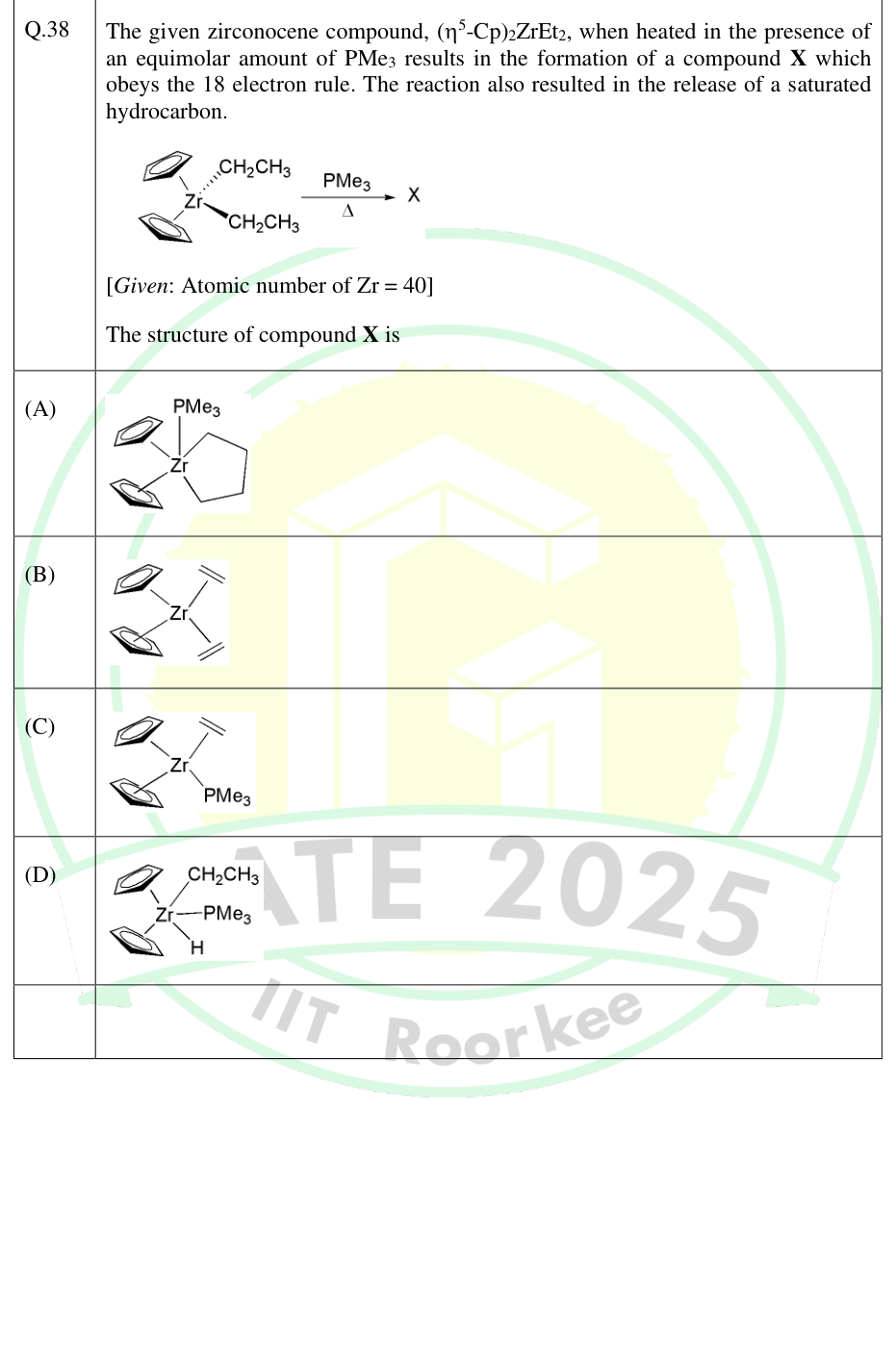
Diethylzirconocene treated with trimethylphosphine and four possible products.
  1. Option A in the figure
  2. Option B in the figure
  3. Option C in the figure
  4. Option D in the figure

Practise this question in The GATE Grind →

Show answer and explanation

Correct answer: (C) Option C in the figure

Explanation

Beta-hydride elimination followed by ethane elimination gives a zirconocene–ethylene species. Coordination of PMe3 yields $4+10+2+2=18$ electrons in C.