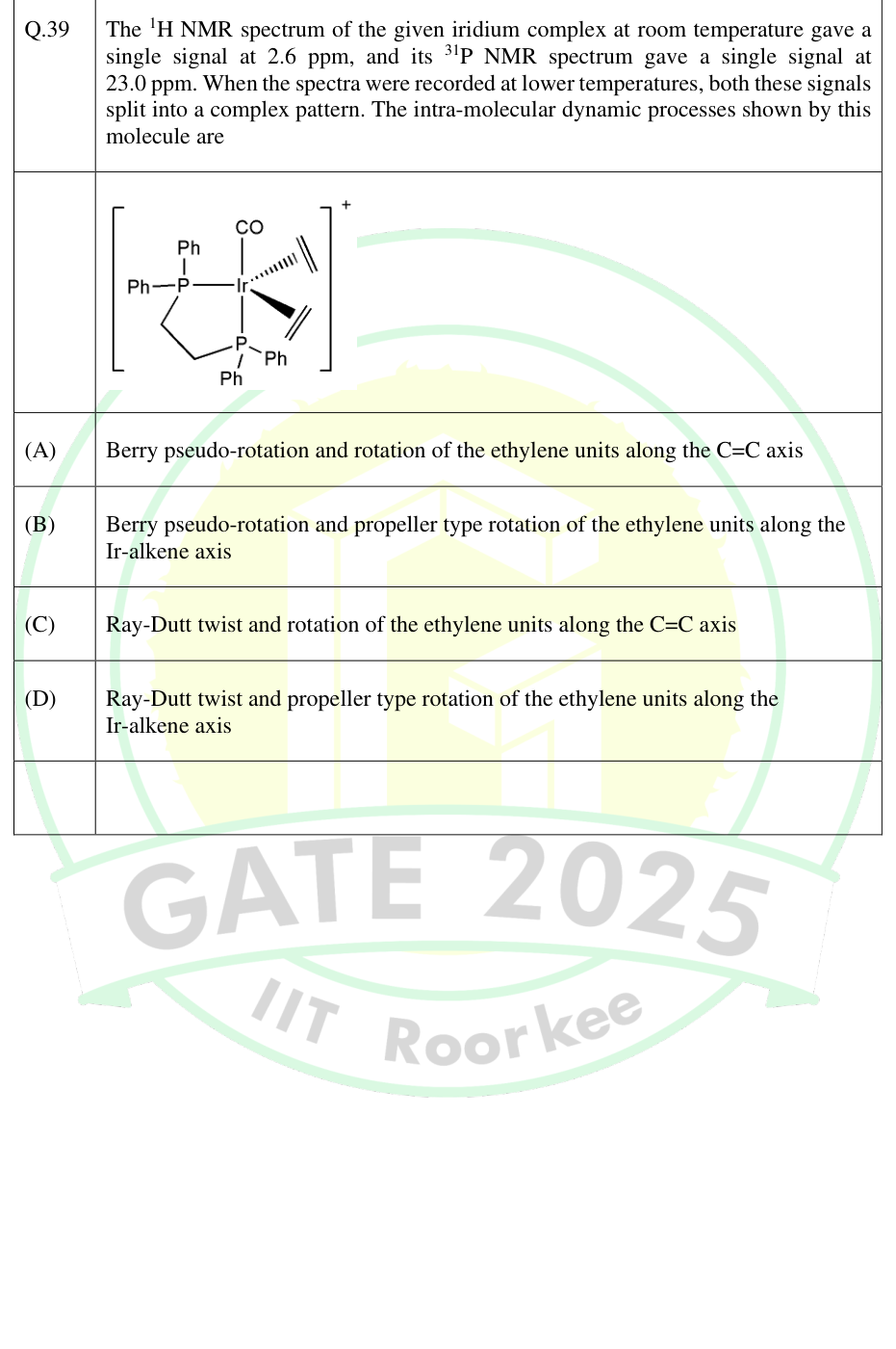
The 1H NMR spectrum of the given iridium complex at room temperature gave a single signal at 2.6 ppm, and its 31P NMR spectrum gave a single signal at 23.0 ppm. When the spectra were recorded at lower temperatures, both these signals split into a complex pattern. The intra-molecular dynamic processes shown by this molecule are
Berry pseudo-rotation and rotation of the ethylene units along the C=C axis
Berry pseudo-rotation and propeller type rotation of the ethylene units along the Ir-alkene axis
Ray-Dutt twist and rotation of the ethylene units along the C=C axis
Ray-Dutt twist and propeller type rotation of the ethylene units along the Ir-alkene axis
Correct answer: (B) Berry pseudo-rotation and propeller type rotation of the ethylene units along the Ir-alkene axis
Explanation
The five-coordinate complex undergoes Berry pseudorotation, exchanging ligand positions. Propeller-like ethylene rotation about the metal–alkene axis exchanges its proton environments; rotation about C=C would break its pi bond.