The GATE Grind

GATE 2022 CY – Question 45

Inorganic Chemistry · Transition Metals: Coordination chemistry – structure and isomerism, theories of bonding (VBT, CFT, and MOT). Metal-metal multiple bonds. Energy level diagrams in various crystal fields, CFSE, applications of CFT, Jahn-Teller distortion. Electronic spectra of transition metal complexes: spectroscopic term symbols, selection rules, Orgel and Tanabe-Sugano diagrams, nephelauxetic effect and Racah parameter, charge-transfer spectra. Magnetic properties of transition metal complexes. Ray-Dutt and Bailar twists, Reaction mechanisms: kinetic and thermodynamic stability, associative, dissociative substitution and redox reactions. · 2 marks · Multiple choice

The rate constants of the following self-exchange electron-transfer reactions at a fixed temperature follow ______. An asterisk denotes a radioactive isotope; bpy is bipyridyl.

Diagram for GATE 2022 CY question 45
  1. $k_{11}>k_{22}>k_{33}$
  2. $k_{22}>k_{11}>k_{33}$
  3. $k_{33}>k_{22}>k_{11}$
  4. $k_{22}>k_{33}>k_{11}$

Practise this question in The GATE Grind →

Show answer and explanation

Correct answer: (B) $k_{22}>k_{11}>k_{33}$

Explanation

Fe(bpy)3 redox partners retain similar low-spin structures and need relatively little inner-sphere reorganization, so k22 is largest. The Fe aqua couple has greater bond-length reorganization and is slower. Co ammine exchange entails a pronounced spin/electronic and bond-length change, so k33 is smallest.
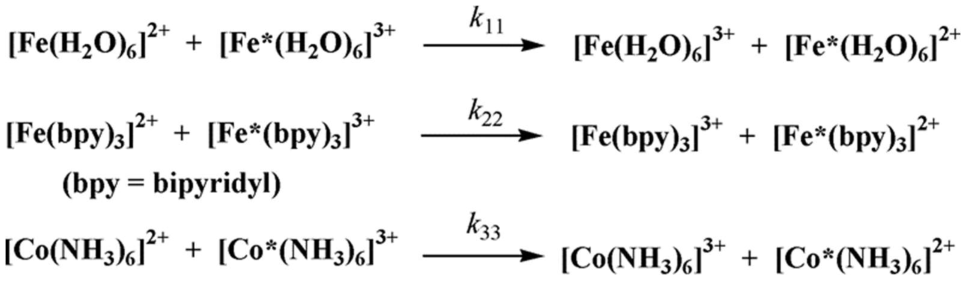
Thus **k22>k11>k33, B**.