Home › Previous year questions › GATE 2021 CY › Question 49GATE 2021 CY – Question 49 Organic Chemistry · Organic Synthesis: Synthesis, reactions, mechanisms and selectivity involving the following classes of compounds – alkenes, alkynes, arenes, alcohols, phenols, aldehydes, ketones, carboxylic acids, esters, nitriles, halides, nitro compounds, amines and amides. Uses of Mg, Li, Cu, B, Zn, P, S, Sn and Si based reagents in organic synthesis. Carbon-carbon bond formation through coupling reactions – Heck, Suzuki, Stille, Sonogashira, Negishi, Kumada, Hiyama, Tsuji-Trost reactions; olefin metathesis, McMurry coupling and Buchwald-Hartwig amination reactions. Baylis-Hillman, Henry, Ritter, Sakurai, Tebbe olefination, Pauson-Khand and Nazarov cyclization reactions. Concepts of multistep synthesis – retrosynthetic analysis, strategic disconnections, synthons and synthetic equivalents. Atom economy and green chemistry, Umpolung reactivity – formyl and acyl anion equivalents. Selectivity in organic synthesis – chemo-, regio- and stereoselectivity. Protection and deprotection of functional groups. Concepts of asymmetric synthesis – resolution (including enzymatic), desymmetrization and use of chiral auxiliaries, organocatalysis. Carbon-carbon and carbonheteroatom bond forming reactions through enolates (including boron enolates), enamines and silyl enol ethers. Stereoselective addition to C=O groups (Cram, Prelog and Felkin-Anh models). Asymmetric aldol reactions – Evans reaction and proline catalyzed reaction. · 2 marks · Multiple choice
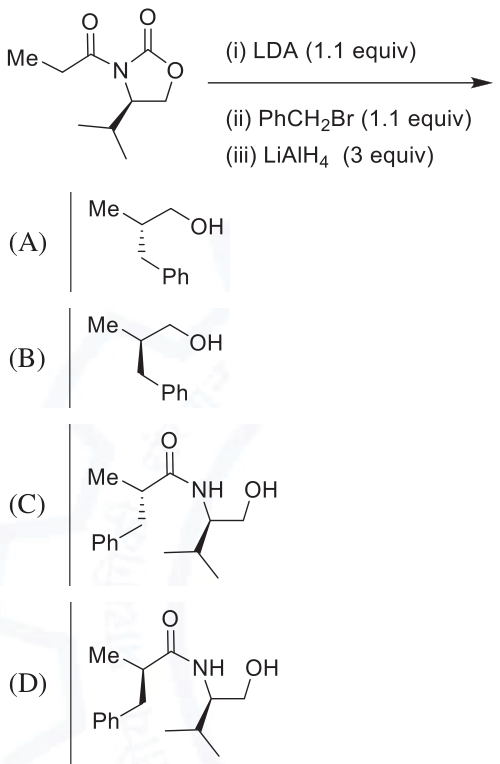
The major product formed in the following reaction is:
Diagram A Diagram B Diagram C Diagram D Practise this question in The GATE Grind →
Show answer and explanation Correct answer: (A) Diagram A
Explanation LDA generates the imide enolate. The chiral oxazolidinone shields one face, so benzyl bromide alkylates from the less hindered face, giving the stereochemistry shown in A. Three equivalents of LiAlH4 reduce the acyl group and cleave the auxiliary, producing the primary alcohol without breaking the newly formed stereogenic C–C bonds. The product is **A**, rather than an auxiliary-containing amide.