GATE 2026 EC – Question 50
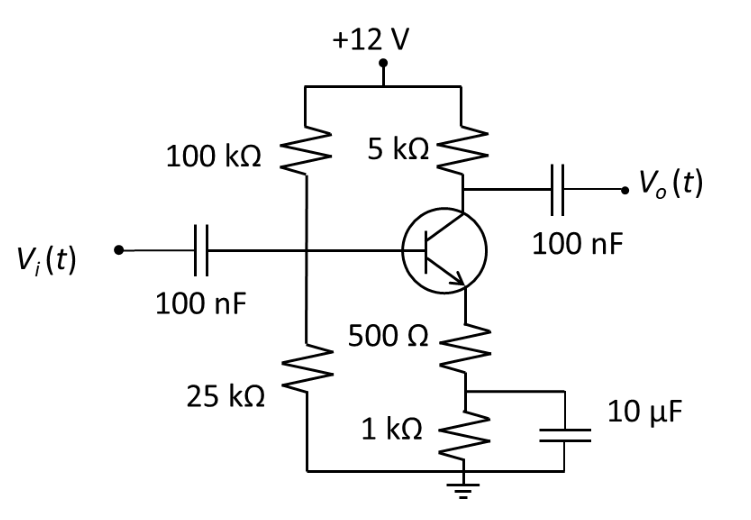
A small signal source, $V_i(t)=A\cos(10^5t)+B\sin(10^7t)$ is applied to a BJT circuit as shown in the Figure. Assume zero source resistance, $V_{BE}=0.7$ V, $\beta_{dc}=99$, Early voltage $=100$ V and Thermal voltage $=25$ mV. Effect of internal parasitic capacitances of the BJT may be neglected. Which expression is the best approximation of the output voltage $V_o(t)$?
Practise this question in The GATE Grind →
Show answer and explanation
Correct answer: (A) $-9.1[A\cos(10^5t)+B\sin(10^7t)]$
Explanation
Bias gives $V_{TH}=2.4$ V and $R_{TH}=20$ kΩ, so $I_B\approx10\ \mu$A, $I_C\approx1$ mA, $r_\pi\approx2.5$ kΩ. At both frequencies the capacitors are effectively short, leaving 500 Ω unbypassed. So $A_v\approx-\beta R_C/(r_\pi+(\beta+1)500)\approx-9$, closest to −9.1, and it is the same for both tones.