GATE 2016 CE (CE1) – Question 42
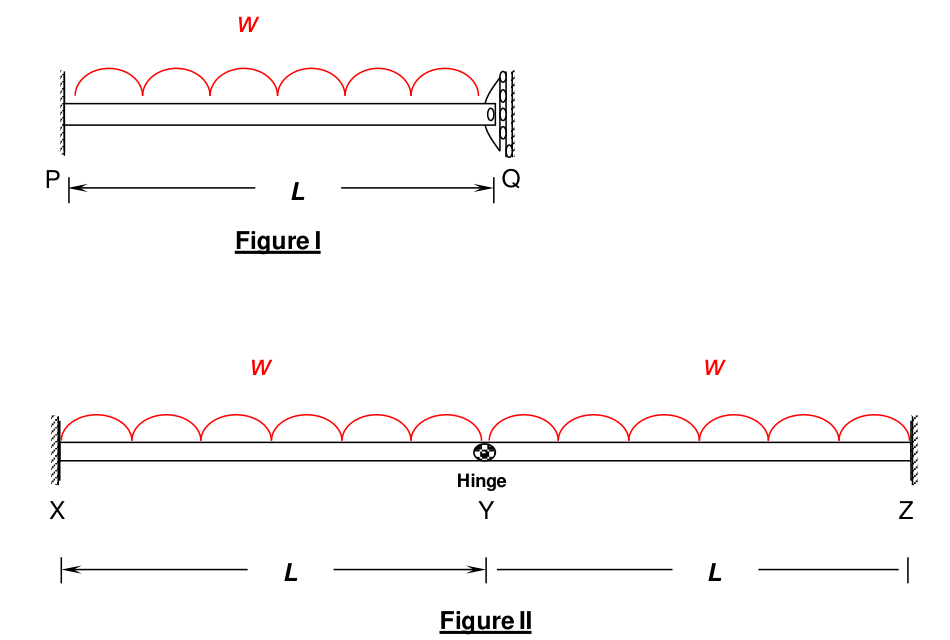
Two beams PQ (fixed at P and with a roller support at Q, as shown in Figure I, which allows vertical movement) and XZ (with a hinge at Y) are shown in the Figures I and II respectively. The spans of PQ and XZ are L and 2L respectively. Both the beams are under the action of uniformly distributed load (W) and have the same flexural stiffness, EI (where, E and I respectively denote modulus of elasticity and moment of inertia about axis of bending). Let the maximum deflection and maximum rotation be δmax1 and θmax1, respectively, in the case of beam PQ and the corresponding quantities for the beam XZ be δmax2 and θmax2, respectively. Which one of the following relationships is true?
Practise this question in The GATE Grind →
Show answer and explanation
Correct answer: (D) δmax1 = δmax2 and θmax1 = θmax2
Explanation
The roller at Q supplies no vertical reaction, so PQ bends as a cantilever under the vertical UDL. Symmetry of XZ makes the vertical force at its central internal hinge zero; each identical half therefore also bends as a free-ended cantilever of length L. Both have end deflection wL⁴/(8EI) and end-slope magnitude wL³/(6EI). The comparison is **D**.