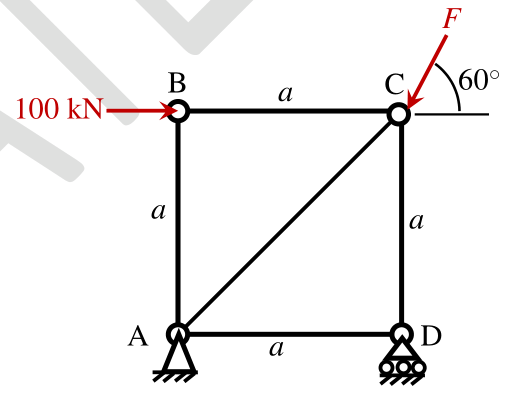
In the shown square truss ABCD of side a, diagonal AC is an inextensible string and other members are rigid. Find the maximum F for static equilibrium (two decimal kN).
The string can carry tension but not compression. Joint B equilibrium with 100 kN directed right makes BC a 100 kN compressive member. At C its horizontal action is therefore 100 kN right, while applied F has leftward component F cos60°. With AC at 45°, $100-F/2-T/\sqrt2=0$. Nonnegative string tension requires F ≤ 200 kN. Hence the limiting value is **200.00 kN**.
More Applied Mechanics questions
GATE 2024 PI Q50– A metal cylindrical air vessel has mean radius 1 m and wall thickness 4 mm. Allowable…
GATE 2023 PI Q24– A thin cylinder has length L, diameter d, wall thickness t, Young’s modulus E and Poisson…
GATE 2023 PI Q39– A massless beam is fixed at one end and supported by a roller at the other. A downward…
GATE 2022 PI Q14– An isotropic material has shear modulus G. What is the maximum possible Young’s modulus?
GATE 2022 PI Q28– Yield begins at principal stresses 100,100,200 MPa. Find uniaxial yield stress according…
GATE 2022 PI Q40– In the shown three-member truss, AC = BC. A 10 kN force acts leftward at B parallel to AC.…