GATE 2017 CE (CE1) – Question 43
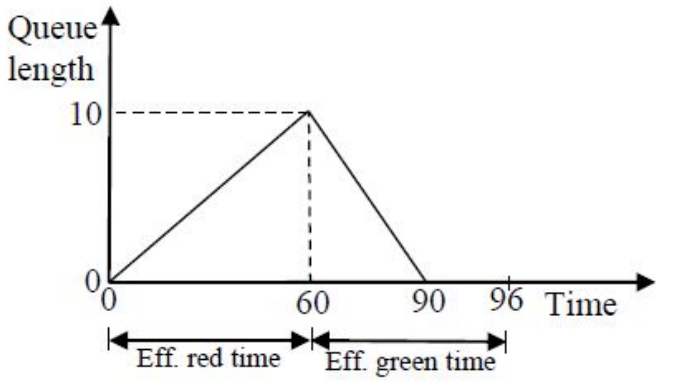
The figure shows queue length versus time at a signalized intersection with a 96 s cycle. At $t=0$ the signal turns red. Effective green lasts 36 s and saturation discharge rate is $s$ vph. Arrivals are uniform at $v$ vph throughout the cycle. Which statement is true?
Practise this question in The GATE Grind →
Show answer and explanation
Correct answer: (B) $s=1800$ vph; average stopped delay = 28.125 s/vehicle.
Explanation
The queue grows to 10 vehicles over the 60 s red, so $v=10(3600)/60=600$ vph. It clears in 30 s of green, so $s-v=10(3600)/30=1200$ and $s=1800$ vph. The area under the queue curve is $\frac12(90)(10)=450$ vehicle-seconds. Arrivals per cycle are $600(96)/3600=16$, giving average delay $450/16=28.125$ seconds. Thus B.
More Traffic signs, signal design by Webster method, intersections and interchanges questions
- GATE 2022 CE (CE1) Q62
- GATE 2022 CE (CE2) Q65
- GATE 2021 CE (CE1) Q35
- GATE 2021 CE (CE2) Q34
- GATE 2020 CE (CE2) Q19
- GATE 2019 CE (CE2) Q54
All Traffic signs, signal design by Webster method, intersections and interchanges questions →