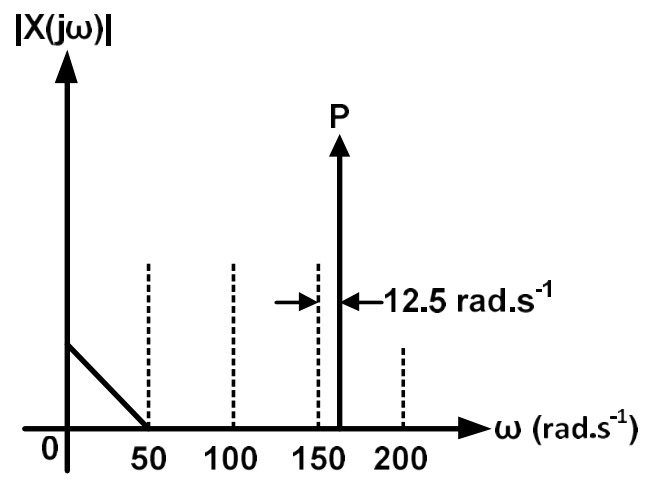
A real continuous-time signal has the magnitude spectrum shown. After sampling at angular frequency 100 rad/s, to what nonnegative baseband frequency in rad/s does spectral point P down-convert?
The graph places P 12.5 rad/s above 150, so its original frequency is 162.5 rad/s. Subtract two sampling-frequency intervals to obtain −37.5 rad/s. For a real signal, the corresponding positive-frequency location is 37.5 rad/s, D, within the baseband ±50 rad/s.
More Signals and Sampling questions
GATE 2022 BM Q15– The discrete signals x[n] and y[n] are shown. Find their zero-lag cross-correlation rₓᵧ[0]…
GATE 2022 BM Q18– Find the time separation in seconds between corresponding peaks of v₁(t)=2cos(6t+60°) and…
GATE 2021 BM Q42– An analog signal sampled at 100 MHz produces 1024 samples. Only those samples are used for…
GATE 2025 BM Q36– For x(t)=20(100 t)+36(150 t)-2(300 t) with t in seconds, which sampling frequency permits…
GATE 2023 BM Q33– A band-limited continuous signal has X(f)=1- f /200 for f 200 Hz and zero otherwise. It is…