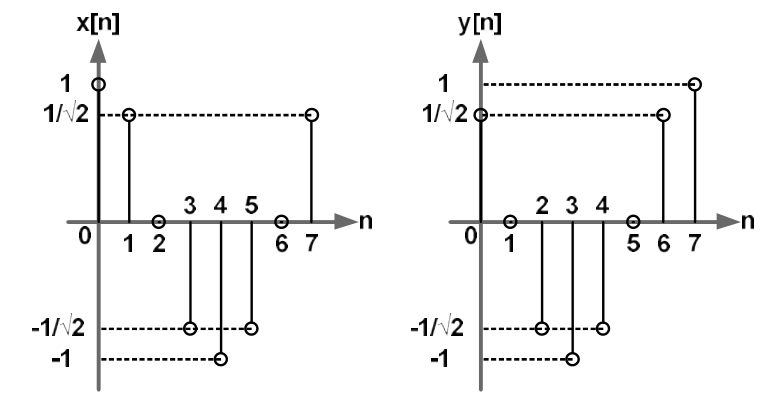
The discrete signals x[n] and y[n] are shown. Find their zero-lag cross-correlation rₓᵧ[0] using the average over the eight shown samples. The source labels the quantity rₓᵧ[0] without stating this normalization.
At zero lag the nonzero products occur at n=0,3,4,7, each equal to 1/√2. Their sum is 2√2. The official B uses the average over eight samples: r[0]=(2√2)/8=1/(2√2). An unnormalized finite-sequence cross-correlation sum would instead be A; the source omits that convention, so the official normalization is made explicit here.
More Signals and Sampling questions
GATE 2022 BM Q18– Find the time separation in seconds between corresponding peaks of v₁(t)=2cos(6t+60°) and…
GATE 2021 BM Q42– An analog signal sampled at 100 MHz produces 1024 samples. Only those samples are used for…
GATE 2025 BM Q36– For x(t)=20(100 t)+36(150 t)-2(300 t) with t in seconds, which sampling frequency permits…
GATE 2023 BM Q33– A band-limited continuous signal has X(f)=1- f /200 for f 200 Hz and zero otherwise. It is…
GATE 2022 BM Q14– A real continuous-time signal has the magnitude spectrum shown. After sampling at angular…