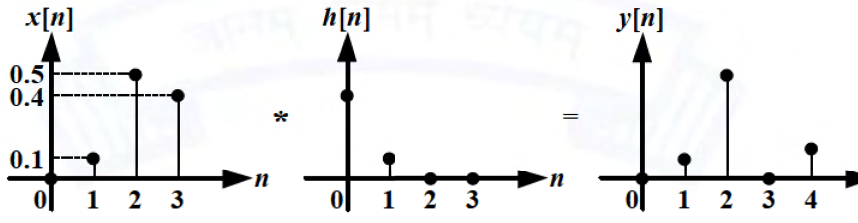
The nonzero input samples are x[1]=.1,x[2]=.5,x[3]=.4; h is supported at zero and one. Thus y[2]=.5h[0]+.1h[1]=1 and y[3]=.4h[0]+.5h[1]=0. The second equation gives h[1]=−.8h[0]. Substitution yields .42h[0]=1, so h[0]=2.38095, D.
More LTI Systems and Convolution questions
GATE 2026 BM Q63– An LTI system has h[n]=[0,0.6,0.8,0.5,0.3,0] and input x[n]=[1,0.6,0,0,0,0], both indexed…
GATE 2025 BM Q44– Systems U,V are defined by U: y(t)=x(t)²+1 and V: y(t)=x(t+1). Which are correct?
GATE 2025 BM Q47– An LTI system has h[n]=δ[n]+δ[n−1]/2+δ[n−2]/3. Input is x[n]=δ[n]+δ[n−1]. Which output…
GATE 2024 BM Q24– An LTI system obeys y(t)+y′(t)+0.5y″(t)=x(t)+0.1x′(t). Find the Laplace transform of its…
GATE 2024 BM Q59– x[n]=u[n]−u[n−5],h[n]=δ[n]−δ[n−1],and y=x*h. Find the sum of y[n] over all integers n, as…
GATE 2023 BM Q47– Sequences x₁[n] and x₂[n] have samples [1,2,1] and [1,1,2] respectively for n=0,1,2 and…