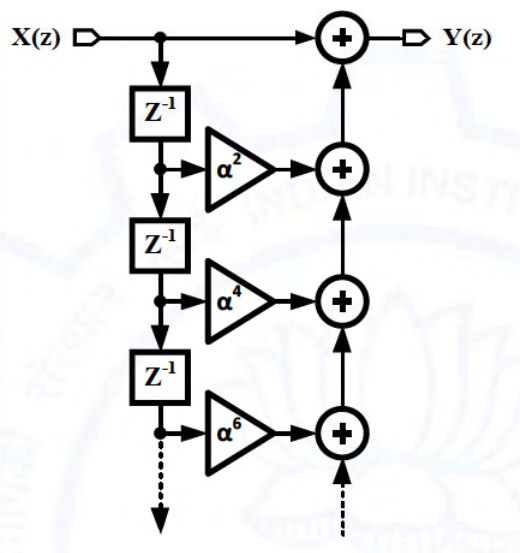
Expand the target as a geometric series: H=1+.5z⁻¹+.25z⁻²+.125z⁻³+⋯. The first delayed coefficient in the diagram is α², so α²=.5 and positive α=1/√2, B. Higher tap weights then match automatically as powers of .5. Although the source calls it an infinite-tap FIR, the infinite-duration response is ordinarily described as IIR.
More Digital Filters questions
GATE 2020 BM Q42– Two first-order low-pass filters H 1(j)=1/(1+j/ 1) and H 2(j)=1/(1+j/ 2) are cascaded.…
GATE 2026 BM Q41– A moving-average filter obeys y[n]=(x[n]+2x[n−1]+x[n−2])/4. Which describes its transfer…
GATE 2025 BM Q12– Which frequency-response curve is that of a notch filter?
GATE 2024 BM Q23– The shown asymptotic Bode magnitude of a second-order low-pass filter has its corner at 1…
GATE 2023 BM Q17– A two-tap FIR filter has impulse response h[0]=h[1]=1 and all other samples zero. What is…
GATE 2022 BM Q39– For the shown two-tap high-pass FIR filter, H(z)=Y(z)/X(z). The maximum-to-minimum…