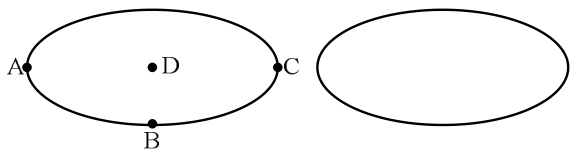
Inside a conducting electrode the electrostatic field is zero, excluding D. On a curved surface the field is stronger where charge density concentrates, usually near smaller radii of curvature.
A and C are sharper than B, but the facing same-potential electrode shields the gap-facing side C. The exposed outer tip A therefore has the greatest field among the marked points. Hence **A**.
More Coulomb's Law, Electric Field Intensity, Electric Flux Density, Gauss's Law, Divergence questions
GATE 2015 EE (EE2) Q46– Two grounded perpendicular semi-infinite conducting sheets are shown. Charge +Q is…
GATE 2026 EE Q15– A uniform ring charge of radius R carries a total charge Q. Which one of the following…
GATE 2026 EE Q63– A uniform spherical volume charge distribution of radius 2 m, centered at the origin, has…
GATE 2025 EE Q25– Which one of the following figures represents the radial electric field distribution E R…
GATE 2024 EE Q51– In the (x,y,z) coordinate system, three point-charges Q, Q, and Q are located in free…
GATE 2022 EE Q53– As shown in the figure below, two concentric conducting spherical shells, centered at r=0…