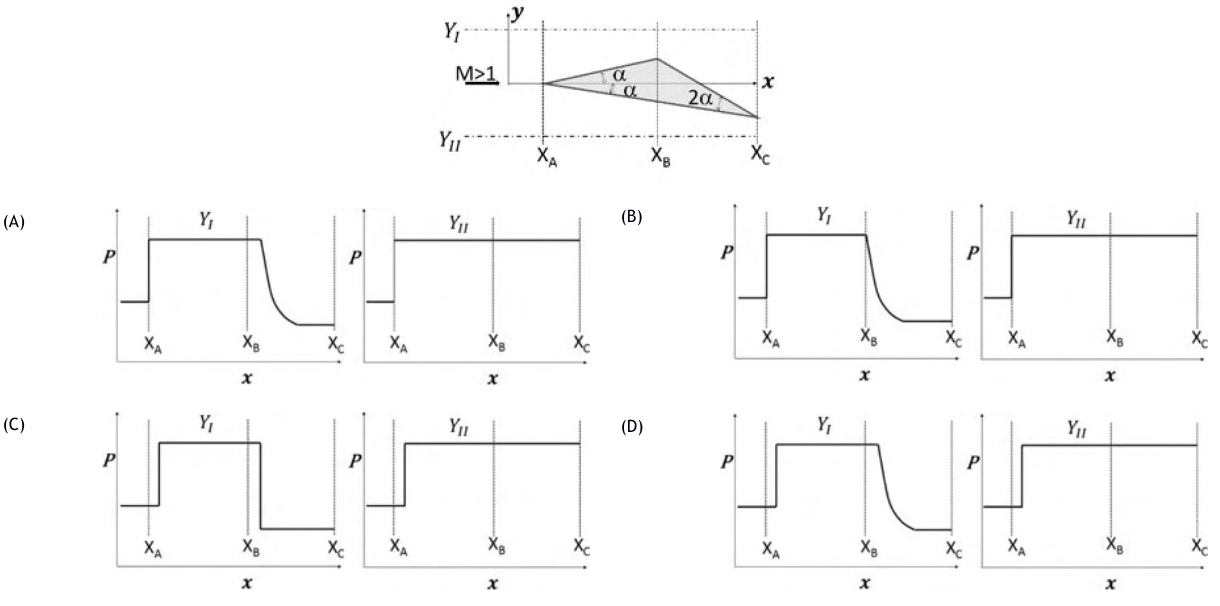
Compression at the leading corner creates oblique shocks and a pressure rise. Along the line above the airfoil, the leading shock is crossed downstream of xA, and the expansion fan from the upper corner begins influencing that line downstream of xB, producing a continuous pressure decrease. The line below crosses its compression shock downstream of xA and stays at its elevated pressure over the drawn range. D shows the downstream shock crossings and the finite expansion-fan region; treating the pressure jump as located exactly at the surface corner or making the fan a discontinuous jump is incorrect.
More Compressible flows: isentropic flow, normal and oblique shocks, Prandtl-Meyer flow, nozzles and diffusers questions
GATE 2020 AE Q49– An oblique shock is inclined 35° to upstream velocity 517.56 m/s. Flow deflection is 5.75°…
GATE 2019 AE Q16– For quasi-one-dimensional isentropic supersonic flow through a diverging duct,
GATE 2019 AE Q37– An incident weak oblique shock is reflected as a weak oblique shock from the wall, as…
GATE 2019 AE Q47– Across a stationary normal shock, p 2/p 1=1+[2/(+1)](M 12-1). Upstream air has speed 800…
GATE 2024 AE Q22– On Day 1, an aircraft flies with a speed of V 1 m/s at an altitude where the temperature…
GATE 2024 AE Q23– Consider a steady, isentropic, supersonic flow (Mach number M > 1) entering a…