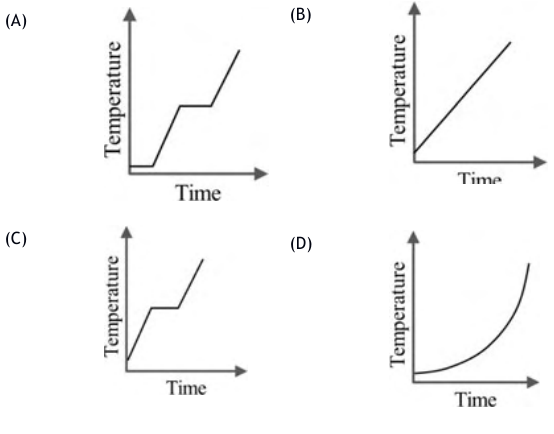
A block of ice at 0°C receives heat at a constant rate and is converted to superheated steam. Assume the specific heat of H₂O is independent of temperature. Which temperature–time trajectory is correct?
During initial melting, latent heat is absorbed at constant 0°C, producing a plateau. Liquid water then warms linearly under constant heating and constant heat capacity. Boiling produces a second plateau, followed by a rising steam-temperature segment. Only graph A has this plateau–rise–plateau–rise sequence. The question implicitly uses a fixed pressure for the phase transitions.
More Bioreaction Engineering: Rate law, zero and first order kinetics, Michaelis-Menten kinetics and enzyme inhibition questions
GATE 2019 BT Q26– Which is the unit of heat-transfer coefficient?
GATE 2019 BT Q28– Which need NOT be conserved in a biochemical reaction?
GATE 2019 BT Q33– Find the degree of reduction of acetic acid, C₂H₄O₂.
GATE 2019 BT Q34– Find the mass of 1 kmol oxygen molecules in grams, nearest integer.
GATE 2019 BT Q61– Yeast biomass C 6H 10O 3N grows on glucose as alignedC 6H 12O 6+0.48NH 3+3O 2\\0.48C 6H…
GATE 2026 BT Q32– You are characterizing a new enzyme isolated and purified in the laboratory. If the…