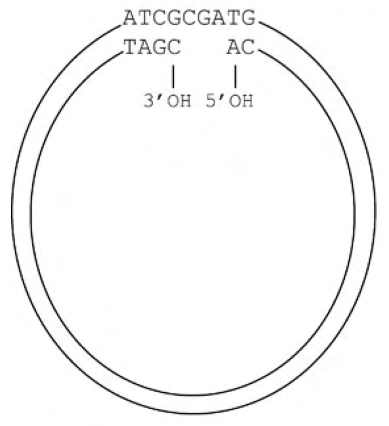
The plasmid shown has a gap in one DNA strand, ending in 3′ OH and 5′ OH. Which enzymes are needed to fill the gap and form a covalently closed circular plasmid?
[P] DNA ligase; [Q] alkaline phosphatase; [R] DNA polymerase; [S] polynucleotide kinase.
DNA polymerase extends the available 3′ OH using the intact strand as template, filling the missing nucleotides. The 5′ OH at the other edge must be phosphorylated by polynucleotide kinase to provide a 5′ phosphate. DNA ligase can then seal the remaining nick. Alkaline phosphatase would remove phosphate and hinder ligation. Thus P, R and S, B.
More Recombinant DNA technology: Restriction and modification enzymes, vectors, expression vectors, libraries, gene isolation and cloning, transposons, gene targeting questions
GATE 2020 BT Q53– A random 1 Mb DNA has equal proportions of all four bases. On average, how many…
GATE 2019 BT Q11– The Bt-toxin gene from Bacillus thuringiensis used to generate genetically modified crops…
GATE 2023 BT Q45– Which of the following vector(s) is(are) used to clone a DNA fragment of size 220 kb?
GATE 2022 BT Q25– The recognition sequences of four Type-II restriction enzymes (RE) are given below. The…
GATE 2022 BT Q64– A circular plasmid has three different but unique restriction sites for enzymes ‘a’, ‘b’…
GATE 2021 BT Q19– Which technique is NOT used for inserting a foreign gene into a cell?