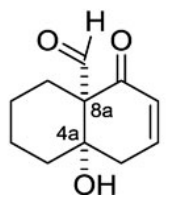
Apply CIP ordering separately at the two ring junctions, following each carbon path until the first difference and treating carbonyl double bonds by duplicate-atom rules. At 4a, OH has the highest priority; the carbonyl-containing path outranks the less substituted saturated path. At 8a, compare the carbonyl-bearing paths and the formyl substituent rather than ranking carbons by their visual position. Orient the lowest-priority group away using the drawn dashed bonds. The resulting descriptors are 4aS and 8aR, D.
More Stereochemistry: Chirality and symmetry of organic molecules with or without chiral centres and determination of their absolute configurations and optical purity. Relative stereochemistry in compounds having more than one stereogenic centre. Homotopic, enantiotopic and diastereotopic atoms, groups and faces. Conformational analysis of acyclic and cyclic compounds. Geometrical isomerism and optical isomerism. Configurational and conformational effects, atropisomerism, and neighbouring group participation on reactivity and selectivity/specificity. Stereoselective and stereospecific synthesis. Enantiomeric excess. questions
GATE 2020 CY Q41– The shown chiral α-bromopropionic acid reacts with OH⁻ to give α-hydroxy acid P, or with…
GATE 2020 CY Q54– Among the six boxed pairs of structures shown, how many pairs are diastereomeric?
GATE 2019 CY Q24– Among the six illustrated compounds, how many do NOT exhibit optical activity at room…
GATE 2019 CY Q56– Pure (R)-2-bromobutane has specific rotation −112.00°. A sample rotates −82.88°. Find the…