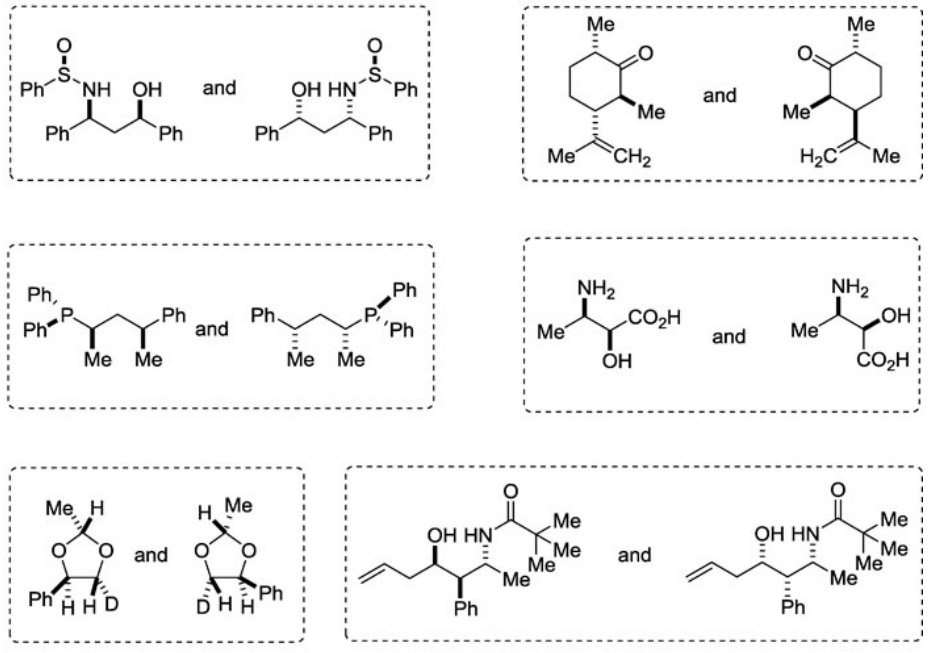
Compare corresponding stereogenic centres after putting each pair into the same orientation. Reading the six boxes row by row: upper left is diastereomeric (include the stereogenic sulfur); upper right is diastereomeric; middle left is identical after reorientation; middle right is diastereomeric; lower left is diastereomeric (H and D distinguish the labelled sites); lower right is an enantiomeric pair because all its stereogenic carbon centres invert. Diastereomers differ at some, but not all, stereochemical elements. The qualifying boxes are therefore upper left, upper right, middle right and lower left: four pairs. A phosphorus carrying two identical phenyl groups must not be counted as an additional stereocentre.
More Stereochemistry: Chirality and symmetry of organic molecules with or without chiral centres and determination of their absolute configurations and optical purity. Relative stereochemistry in compounds having more than one stereogenic centre. Homotopic, enantiotopic and diastereotopic atoms, groups and faces. Conformational analysis of acyclic and cyclic compounds. Geometrical isomerism and optical isomerism. Configurational and conformational effects, atropisomerism, and neighbouring group participation on reactivity and selectivity/specificity. Stereoselective and stereospecific synthesis. Enantiomeric excess. questions
GATE 2019 CY Q24– Among the six illustrated compounds, how many do NOT exhibit optical activity at room…
GATE 2019 CY Q56– Pure (R)-2-bromobutane has specific rotation −112.00°. A sample rotates −82.88°. Find the…