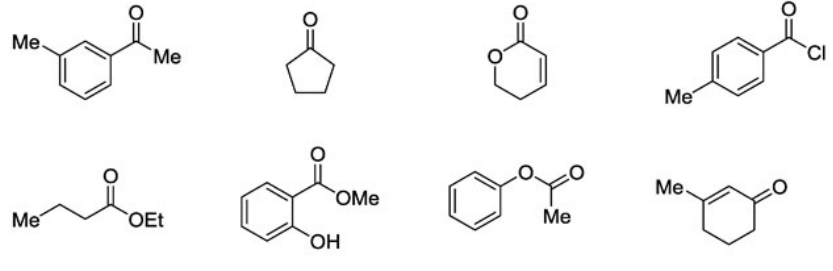
Conjugation lowers carbonyl stretching frequency by reducing effective C=O bond order, and intramolecular hydrogen bonding can lower it further. The qualifying structures are the aryl-conjugated ketone, the ortho-hydroxy aromatic ester with intramolecular hydrogen bonding, and the conjugated cyclohexenone. The unconjugated cyclopentanone, ordinary ester, acid chloride, phenyl acetate and the non-carbonyl-conjugated lactone do not meet the threshold. The count is 3.
More Experimental Techniques in Organic Chemistry: Optical rotation (polarimetry). Application of various chromatographic techniques such as thin-layer, column, HPLC and GC. Applications of UV-visible, IR, NMR spectroscopy and Mass spectrometry in the structural determination of organic molecules. questions
GATE 2019 CY Q26– How many distinct ¹H NMR signals are expected for the illustrated compound?
GATE 2024 CY Q16– The major product in the given reaction sequence is Q. The mass spectrum of Q shows ([M] =…
GATE 2024 CY Q32– 1H NMR spectrum of a mixture containing CH 3Br (x mol) and (CH 3) 3CBr (y mol) shows two…
GATE 2024 CY Q40– Consider the following 1H-NMR (400 MHz, DMSO-d 6) data of a compound: in ppm: 3.85 (s,…
GATE 2025 CY Q16– In the 1H-NMR spectrum of the following molecule, the signal of proton H a appears as
GATE 2025 CY Q24– Compound(s) that show(s) an intense peak at m/z 120 in the EI mass spectrum is/are