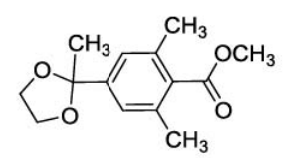
The symmetry-related aromatic hydrogens give one signal, and the two symmetry-related aryl methyl groups give another. The ester methoxy and acetal methyl each give one further signal. In the dioxolane ring, the two methylene groups are symmetry-related but their two proton classes are chemically distinct in this environment, giving two signals. Total 1+1+1+1+2=6.
More Experimental Techniques in Organic Chemistry: Optical rotation (polarimetry). Application of various chromatographic techniques such as thin-layer, column, HPLC and GC. Applications of UV-visible, IR, NMR spectroscopy and Mass spectrometry in the structural determination of organic molecules. questions
GATE 2024 CY Q16– The major product in the given reaction sequence is Q. The mass spectrum of Q shows ([M] =…
GATE 2024 CY Q32– 1H NMR spectrum of a mixture containing CH 3Br (x mol) and (CH 3) 3CBr (y mol) shows two…
GATE 2024 CY Q40– Consider the following 1H-NMR (400 MHz, DMSO-d 6) data of a compound: in ppm: 3.85 (s,…
GATE 2025 CY Q16– In the 1H-NMR spectrum of the following molecule, the signal of proton H a appears as
GATE 2025 CY Q24– Compound(s) that show(s) an intense peak at m/z 120 in the EI mass spectrum is/are
GATE 2025 CY Q42– Compound K has a strong IR band at 1680 cm−1. Its 1H NMR data: (ppm) 7.30 (d, J = 7.2 Hz,…