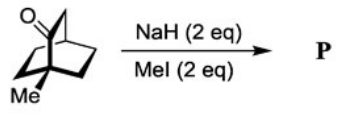
The shown bicyclic ketone reacts with NaH (2 equivalents) and MeI (2 equivalents) to form major product P. How many broadband proton-decoupled ¹³C NMR peaks does P exhibit?
NaH forms the enolate at the carbonyl-adjacent methylene and methyl iodide alkylates that carbon. Two equivalents replace its two hydrogens, forming a gem-dimethyl centre. Together with the original bridgehead methyl, the product has eleven carbons: eight skeletal carbons and three methyl carbons. A symmetry plane makes corresponding carbons of the two unsubstituted bridges equivalent (two pairs), and the two newly introduced methyl carbons form another equivalent pair. Thus eleven carbons give 11−2−1 = 8 distinct environments. Proton decoupling removes C–H splitting but does not change this chemical-equivalence count.
More Experimental Techniques in Organic Chemistry: Optical rotation (polarimetry). Application of various chromatographic techniques such as thin-layer, column, HPLC and GC. Applications of UV-visible, IR, NMR spectroscopy and Mass spectrometry in the structural determination of organic molecules. questions
GATE 2020 CY Q39– A compound C₁₀H₁₂O₂ has a strong IR band near 1720 cm⁻¹, a mass-spectrum peak at m/z 122,…
GATE 2020 CY Q55– Among the eight compounds shown, how many have characteristic carbonyl-stretching…
GATE 2019 CY Q26– How many distinct ¹H NMR signals are expected for the illustrated compound?
GATE 2024 CY Q16– The major product in the given reaction sequence is Q. The mass spectrum of Q shows ([M] =…
GATE 2024 CY Q32– 1H NMR spectrum of a mixture containing CH 3Br (x mol) and (CH 3) 3CBr (y mol) shows two…
GATE 2024 CY Q40– Consider the following 1H-NMR (400 MHz, DMSO-d 6) data of a compound: in ppm: 3.85 (s,…