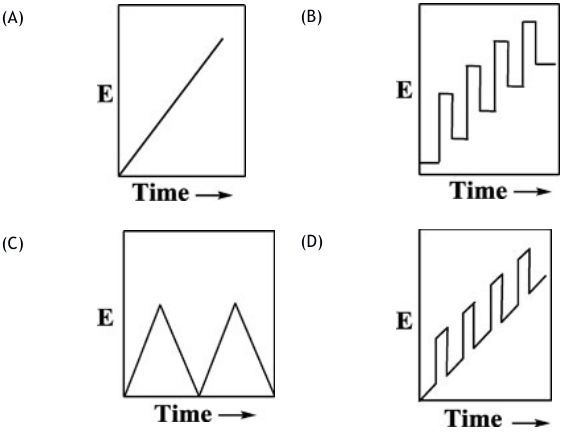
Cyclic voltammetry sweeps electrode potential linearly with time to a switching potential, then reverses the scan direction. Repeated forward and reverse scans form a triangular waveform, C. A single ramp is linear-sweep excitation, while the stepped and pulsed waveforms represent other voltammetric methods.
More Instrumental Methods of Analysis: UV-visible, fluorescence and FT-IR spectrophotometry, NMR and ESR spectroscopy, mass spectrometry, atomic absorption spectroscopy, Mössbauer spectroscopy (Fe and Sn) and X- ray crystallography. Electroanalytical methods – cyclic voltammetry, ion-selective electrodes. Thermo-analytical methods: TGA, DTA and DSC. questions
GATE 2020 CY Q57– How many g∥ lines are expected for a solution of bis(salicylaldimine)copper(II) containing…
GATE 2019 CY Q28– Heating 25 mg of a hydrated compound of molar mass 250 g/mol leaves 16 mg of dehydrated…
GATE 2019 CY Q39– For a methyl radical’s EPR spectrum, what are the number of lines and their relative…
GATE 2024 CY Q37– In the EPR spectrum of an aqueous solution of VOSO 4 at room temperature, the total number…
GATE 2024 CY Q60– In thermogravimetric analysis, 12.45 mg of CuSO 45H 2O was heated under nitrogen. At a…
GATE 2025 CY Q31– The total number of hyperfine lines expected in the EPR spectrum of CH 2OH (radical) is…